Sunday, November 27, 2016

Blog CCXI (211): Patton as an Academic

Mark Grimsley
Mark Grimsley of The Ohio State University is one of the leading military historians in the profession.  He writes primarily on the Civil War time period.  His first book was: The Hard Hand of War: Union Military Policy Toward Southern Civilians, 1861-1865 (New York: Cambridge University Press, 1995), which won the Lincoln Prize.  He has written, co-written, or edited five others.  He has won three teaching awards at OSU.  He is also a blogger of the first order.  He developed the website, Facebook page, and blog of the Society for Military.  His website is warhistorian.org and the blog of that website is: "Blog Them Out of the Stone Age: Toward A Broader Vision of Military History and National Security Affairs." 

An essay he posted on "Blog Them Out of the Stone Age" really spoke to me in several ways.  As many of you might note, I wrote a book on the making of the film Patton.  The introduction is the piece of writing I am most proud of at the moment.  I modeled it after the Frank Sinatra film The Manchurian Candidate (1962), cutting back and forth between George C. Scott shooting the scene, the scene itself, and reactions to that section of the film.  (Francis Ford Coppola wrote this section of the script, by gluing several speeches the real Patton gave into one short address).  The chapter that was the most difficult to write was the one, where I discuss all the references to it in films and television shows since  and various other appropriations of the film.  In one of the more clever of these efforts, Grimsley rewrote the scene with Patton as an academic. It begins:
Now I want you to remember that few PhDs ever get the job they really wanted. They get used to taking a job at some college where they feel under-placed.
It ends:
Now, all this stuff about there not being many jobs, much less tenure-track jobs, is absolute gospel. Colleges love to exploit PhDs.  Most real colleges love to make you adjuncts. 
Oh.  I will be proud to lead you gullible fools down the garden path any time I can get my readings course to subscribe 
That’s all.
I am not sure if I should laugh or cry.

Tuesday, November 22, 2016

Blog CCX (210): People News

A couple of new developments in the history business have transpired of late that are worth taking note of.  Here they are:

Benjamin H. Irvin
The Journal of American History has a new editor.  Benjamin H. Irvin, associate professor at the University of Arizona, is taking over the journal and will also serve as associate professor in the department of history at Indiana University, Bloomington. He is the author of Clothed in Robes of Sovereignty: The Continental Congress and the People Out of Doors (2011).   His next book, which is in the works, focuses on veterans of the American Revolution in the early republic period.

Alex Lichtenstien
The American Historical Association is also changing editors. Alex Lichtenstein, professor of history at Indiana University, will take over as editor of the American Historical Review in August of 2017.  Unlike Irvin, Lichtenstein is already a member of the Indiana faculty.  His research focuses on labor history and the struggle for racial justice against the forces of white supremacy.  He is no stranger to the journal.  He served as associate editor of the AHR in 2014–15 and interim editor in 2015–16. He has also been the editor of another academic publication, Safundi: The Journal of South African & American Studies.

Angela Lahr
The blog of the American Historical Association has a feature called "Member Spotlight."  This feature is a series of interviews with individual members of the AHA.  On May 5, the series focused on a friend of the blog: Angela Lahr of Westminster College.  Lahr wrote one of the first entries in the "Eight Questions" series.  To be specific, she wrote Blog CX (110): Eight Questions: Religious History.

Edwin J. Perkins
A few months before, the "Member Spotlight" series focused on another friend of the blog, Edwin J. Perkins, a professor emeritus at the University of Southern California.  We were both at USC at the same time in the mid 1990s.  I never took any classes from him, but he gave me a good deal of professional advice--he was the associate editor of Pacific Historical Review at the time.  He took a look at the first academic article I ever published.  Much of his input  has percolated into this blog in many ways. 

Monday, November 21, 2016

Blog CCIX (209): Faculty Unions the California Case Study

I have never really believed that faculty unions will solve the problems facing history.  With that said, while I am a bit skeptical, I am open-minded.  The Organization of American Historians has published several articles on its blog about the status of contingent faculty.  Donald W. Rogers, an adjunct lecturer in history at both Central Connecticut State University and Housatonic Community College, argues, "The most impressive gains for contingent faculty members have come from local campaigns waged on a campus-by-campus basis."   Labor unions have secured collective bargaining agreements that have the states of  part-time faculty.  "The gold standard for these contracts has been set by faculty associations in Canadian institutions like Concordia University and the California State University system."

Trevor Griffey, a former adjunct professor in the history department at Long Beach State, begs to differ.  He has an interesting article on the blog about his experiences as an adjunct and as a union organizer: "Can Faculty Labor Unions Stop the Decline of Tenure?"  The answer seems to be: not really.  "Arguably, they have slowed the decline of faculty pay and job security more than they have reversed it," Griffey states.  He also explains that two-thirds of all unionized faculty are located in five states: California, Illinois, Michigan, New Jersey, and New York. 

In 2001-2002, the California Faculty Association, the union representing faculty in the California State University system got the California state legislature to commit to having a tenure density of 75 percent.  The results were immediate.  Cal State schools hired nearly 2,000 new faculty positions--all to the good.  The thing is--almost at the same time, the state legislature cut funding to the system by half a billion dollars.  What happened?  Tuition went up, non-teaching elements of the system were cut to the bone, and salaries for faculty went down.  The average is $38,000 and that is in California, which is a bit more expensive than other areas of the country. "The biggest lesson that I take from my brief experience in the CSU system," Griffey observes, "is that college faculty in labor unions currently lack the power to effectively resist or reverse the decline of tenure."  Griffey also notes that administrators are not the real problem, although he admits that many in the Faculty Association disagree with him.  The real problem is the state legislature, which the union is reluctant to criticizes, for partisan reasons.

The essay is interesting and thoughtful, presenting a complex issue without dumbing it down.  I suggest a careful read.

Friday, November 18, 2016

Blog CCVIII (208): Ten Greatest Television and Film College Professors

The most previous post got me to thinking about the portrayals of college professors in film and on television.  I suppose one could write a serious, scholarly article on the topic, but that also seems to suck all the fun out of it.  Below is my list.  My criteria was pretty lose.  I had to have seen the film and the character had to have been a professor at a college or university even if the story line was about another activity, which is true about a lot of them.

Turns out Hollywood finds college professors a pretty interesting lot.  No wonder people keep enrolling in graduate school despite the dire economics of it all!  We do all sorts of things from dating Jennifer Anniston to finding the Holy Grail, and helping win the Cold War to documenting the nature of human society for aliens from outer space.  Enjoy:
the-paper-chase-john-houseman
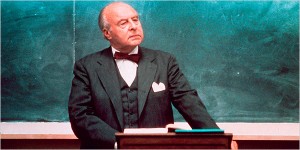
10)  Charles W. Kingsfield, Jr. (John Houseman) The Paper Chase (1973)
Houseman won an Academy Award as best supporting actor for this role. A writer, director, and producer, Houseman was the director of the drama division at The Juilliard School.   His students included Kevin Kline, Patti LuPone, Mandy Patinkin, Christopher Reeve, and Robin Williams.  Kingsfield was first major acting job.  At least one of his former students said Houseman was not acting.  The thing that is different about this role from most of the others on this list is that that Kingsfield's main activity on screen is teaching.  It also is probably the most realistic portrayal of a college professor.


9)  Professor Terguson (Sam Kinison) Back to School (1986)
Kinison's role in this film is quite small, but Terguson makes this list mainly because he is a historian.  Kinison was a stand up comic, and in his main scene, he delivered his lines in the screaming style that characterized his night club routines:
Terguson: You remember that thing we had about 30 years ago called the Korean conflict? And how we failed to achieve victory? How come we didn't cross the 38th parallel and push those rice-eaters back to the Great Wall of China? Then take the fucking wall apart brick by brick and nuke them back into the fucking stone age forever? Tell me why! How come? Say it! Say it!
Thornton Melon: All right. I'll say it. 'Cause Truman was too much of a pussy wimp to let MacArthur go in there and blow out those Commie bastards!
Professor Terguson: Good answer. Good answer. I like the way you think. I'm gonna be watching you.
Thornton Melon (to the camera): Good teacher. He really seems to care. About what I have no idea.

8) Robert Langdon (Tom Hanks) The Da Vinci Code (2006) Angels & Demons (2009) and Inferno (2016)
In Dan Brown's novels and the films, Langdon is a professor of religious symbology at Harvard University.  There is no actual field of "religious symbology."  What Langdon does is really art history.  Does not sound as cool, though. 


7)  Richard "Dick" Solomon (John Lithgow) 3rd Rock from the Sun (1996-2001)
Solomon is a professor of physics at Pendleton State University in Rutherford, Ohio and shares an office with Mary Albright, a professor of anthropology.  I always wondered how small Pendleton had to be for professors from such different fields to be sharing an office.  The other thing is that Solomon is an alien sent to Earth to observe the human race.  Lithgow is hilarious in the role and won three Emmy Awards.  Of course, he might have had some help.  His wife is a history professor.


6) Jack Ryan (Alec Baldwin) The Hunt for Red October (1990)
The question is which Jack Ryan?: Baldwin's, Harrison Ford's, Ben Affleck's, or Chris Pine's.  I will go with the original, even though all the things Ryan has done by 31 (Baldwin's age at the time) is pushing the limits of believability: CIA analyst, U.S. Naval Academy history professor, published historian, Ph.D. from Georgetown, a Wall Street trader who made $8 million before going to grad school, and U.S. Naval Academy graduate.  (His undergraduate alma matter is a major difference between the films and books). But The Hunt for Red October has a great line that is from the original novel:
Capt. Marko Ramius: What books did you write?  
Jack Ryan: I wrote a biography of, of Admiral Halsey, called The Fighting Sailor, about, uh, naval combat tactics... 
Capt. Ramius: I know this book!  
Capt. Vasili Borodin: Torpedo impact... 
Capt. Ramius: Your conclusions were all wrong, Ryan... 
Capt. Vasili Borodin: ...10 seconds. 
Capt. Ramius: ...Halsey acted stupidly.

5) Ted Mosby (Josh Radnor) How I Met Your Mother (2005-2013)
Theodore Evelyn Mosby is an architect living and working in New York, New York.  How I Met Your Mother is the story about how he found his wife.  Mosby is telling the story in flashback mode.  In the nine seasons of the television program, he dated 38 women, before finding "the one."  In season four his fiancĂ© leaves him hours before the wedding for her son's father.  In an effort to make things right, her once again boyfriend uses his family connections to get Mosby a job as a professor of architecture at Columbia University as a consolation prize.  Mosby teaches at Columbia even though he only has a bachelor's degree.  (He must of been some type of adjunct).  As it turns out, he and his future wife see each other for the first time when Mosby accidentally enters the wrong classroom on his first day of teaching.  As a professor, his students tend to act as something of an entourage. 
Image result for the professor gilligan's island inventions
4) The Professor (Russell Johnson) Gilligan's Island (1964-1967)
Roy Hinkley, Ph.D. apparently liked Los Angeles and the Dallas/Forth Worth area.  He has degrees from USC, UCLA, TCU, and SMU.  Cool, calm, and rational, he took a lot of books with him for a three hour tour.  The Professor was a learned man and a master of many fields of science, but some things were beyond him.  In the 1987 movie Back to the Beach, Bob Denver played the "Bartender" who was Gilligan in everything but name for legal reasons (the "Bartender" even dressed like Gilligan), and delivered this line:
You know, I lived with a guy for years. A real genius. He could take a couple of these pineapples or a couple of coconuts with some strings and wire and make a nuclear reactor. But he couldn't fix a two-foot hole in a boat. Wanna hear the rest?

3) Peter Venkman (Bill Murray) Ghostbusters (1984) and Ghostbusters II (1989)
Venkman loses his job at Columbia University early in the film--apparently he did not have tenure--and the dean makes the reasons for his dismissal clear:
Doctor... Venkman. We believe that the purpose of science is to serve mankind. You, however, seem to regard science as some kind of dodge... or hustle. Your theories are the worst kind of popular tripe, your methods are sloppy, and your conclusions are highly questionable! You are a poor scientist, Dr. Venkman! 
Venkman then goes on to fame as the leader of the Ghostbusters and saves the city from Gozer the Gozerian, a Summerian god who comes in the form of the Stay Puft Marshmallow Man.


2)  Ross Geller (David Schwimmer) Friends (1994-2004)
Friends was one of the funniest shows on television and dominated the 1990s.  Ross has a Ph.D. in paleontology from Columbia University at age 27, which is possible, but just barely.  At times Schwimmer's portrayal struck me as quite realistic; Ross seems a bit "over devoted" to his field, and is a bit sensitive when people did not treat his title of "doctor" with the same level of respect that they would give a physician,  On the other hand, all he seems to do is hangout with his friends at the local coffee shop, and has a really healthy social life for an academic--he got married and divorced three times and slept with lot of other women.  People have done studies, and come up with numbers ranging from 14 to 17, which is twice the supposed national average.
 

1) Henry "Indiana" Jones, Jr. (Harrison Ford) Raiders of the Lost Ark (1981) Indiana Jones and the Temple of Doom (1984) Indiana Jones and the Last Crusade (1989) and Indiana Jones and the Kingdom of the Crystal Skull (2008)
Not many people know this but Indiana Jones has been played by 7 actors in the 4 films and The Young Indiana Jones Chronicles, an American television series that lasted for 4 seasons.  Despite that fact, Harrison Ford is the actor most associated with this role.  In 2003 the American Film Institute ranked Jones as the second greatest cinematic hero of all time.  He got his Ph.D. in archeology at the University of Chicago and teaches at Marshall College in Connecticut.  He seems to be a specialist in a number of time periods and locals, which is super unrealistic.  But how many of us get to see God evaporate a professional, academic rival into nothing?

Wednesday, November 16, 2016

Blog CCVII (207): Life in Hell

Matt Groening rocketed to fame when he created The Simpsons.  Before that he drew the Life in Hell cartoon.  I remember seeing this cartoon as an undergraduate and laughing hysterically.  Today, it gets a chuckle.  I think that is me and not the cartoon.  Enjoy:

matt groening life in hell

Sunday, November 13, 2016

Blog CCVI(206): The Letter of Recommendation

As I said in my last post, I do not read the blogs of a lot of other historians.  John Fea's blog "The Way of Improvement Leads Home" is an exception and so is Ann M. Little's "Historiann."  In fact, a few weeks ago she wrote a post on the letter of recommendation that I wish I had written: "More From the Mailbag: How Can I Write a Good Letter of Recommendation?"  Here is an excerpt about what makes for a good letter:
the most helpful letters of recommendation are written like the best letters from tenure and promotion referees.  That is, they’re experts in a subfield writing to peers who are experts in other history subfields, and so understand their charge to contextualize and explain the candidate’s research to an intelligent audience of non-specialists.
That might not strike you as all that difficult an undertaking, but you would be surprised.  One of the first things you learn when you are on a search committee is that you do not know the field, the players, or the historiographical issues in debate.  Letters that can explain the importance of his work without spending three pages summarizing the dissertation, chapter by chapter, are extremely helpful.  A good letter will also discuss the candidate's teaching experience and abilities.  This topic is more important than you might think.  In graduate school, we focus on interpretations and research, but most people will find gainful employment in the profession at schools where teaching is the primary focus.  Letters about the candidates research agenda and contributions are good, but they only go so far. 

Little also mentions something else that I have seen:
I’m sure you, the referee, are a big shot in your field, but not everyone will recognize your name and tremble that you have deigned to address words to us on the search committee.
I mentioned much of what I am about to report in Blog LVII, so it is not new, and I am going to name names...as much as I can remember.  I was on a search committee where a we had a candidate that we were keen on.  He had a Ph.D. from Princeton, but was from Dallas, Texas and was teaching at a community college in the Dallas area.  His letters from Princeton were basically useless.  His dissertation advisor wrote a letter that positive, but no more than three sentences long.  He basically figured that his name and the Princeton reputation would carry the day.  (One of the problems with this approach is that we had two Princeton Ph.D.s apply for the job.)  In the end, it was the letter from his supervisor at the Dallas area community college that really explained his strengths and moved him into the interview on campus list.

The comments from Little's post are also worth reading.   

There is also a downside to writing letters of recommendation.  Little discusses that in another posting: "Functioning Like A Senior Scholar with Junior Scholar Prestige and Pay."

Jonathan Wolff over at The Guardian is a bit skeptical about the value of letters of recommendation and hits on an important shortcoming that he makes clear in the title of his essay: "Academic Reference Inflation Has Set In, and Everyone is Simply Wonderful."

How do you get good letters?  Well, if Wolff is right, then everyone gets them.  That is a bit of an issue in grad school, since everyone knows how the game is played.  But not always.  See the essays by John Fea: "On Letters of Recommendation" and "More on Letters of Recommendation."  Also see, Chris Blattman's article for Inside Higher Ed: "Will I Write a Letter for You?"

Friday, November 11, 2016

Blog CCV (205): So What CAN You Do With A History Major?

As a general rule, I try not to read the blogs of other historians.  Some of them are quite good, but they are generally focused on their fields.  I find all sorts of different fields of history interesting, but at some point you have to say, I just cannot keep up with issues developing in U.S. intellectual history, and/or Medieval European history.  History bloggers also tend to wander off topic a bit; I probably have done that a bit, but only a bit; others wanted to use their forums to talk about the 2016 U.S. presidential election, or the Chicago Cubs winning the World Series. 

With those points made, I do every once and a while--more once than while--I visit other history blogs.  One of the better ones out there is John Fea's "The Way of Improvement Leads Home."  Fea is a religious historian of the 19th Century, and chair of the Department of History at Messiah College in Mechanicsburg, Pennsylvania.  Although his blog focuses a lot on his research and teaching areas, Fea moves around the 19th Century a fair deal, and discusses many other history profession issues.

In 2009 Fea started a series on his blog "So What CAN You Do With A History Major?"  The majority of the entries in this series are interviews with history graduates of Messiah College on what they have done with their degree since graduation, but it is more than a little idiosyncratic.  There are re-postings of other articles, multiple posts about the same person, interviews with guidance counselors, and so on.  This series is aimed at convincing undergraduates and/or their parents that a BA in history is not a waste of a college degree.  Despite that fact, it serves a useful purpose for people in graduate school as a way of generating ideas on what they might do if they are unable to line up gainful employment as professional historians:
  1. Introduction to the Series
  2. "Closing the Gap Between the Liberal-Arts and Career Services"
  3. HNN Intern
  4. Famous History Majors
  5. Police Officer
  6. History Professor
  7. Medical Doctor
  8. You Majored in What?
  9. Jonathan M. Young, Chair, National Council on Disability
  10. The Dartmouth Chart
  11. Five Interviews
  12. Salaries
  13. Librarian
  14. A Passion for History 
  15. Katherine Brooks Interview
  16. Janet Vogel, Librarian, Thurmont Maryland Regional Library System
  17. Scott Keyes, "Stop Asking Me My Major"
  18. Matthew Shaffer, "Educating for the Good Life"
  19. Layne Lebo, Minister, Mechanicsburg Brethern in Christ Church
  20. Go Into Business
  21. A Collection of Articles
  22. Sarah Baker, Documentary Film Maker
  23. Tony Horowitz, Reporter/Writer
  24. Amy Bass, NBC
  25. Sonia Nazario, reporter, Los Angles Times
  26. Interview with Katherine Brooks
  27. Allyson Moore Wall Street Journal guest editorial
  28. AHA Today
  29. Financial Analysis
  30. Bill Stone, Director of Forecasting and Financial Operations, Pearson Education
  31. Salaries
  32. Georgiana Iasnik, Systems Specialist
  33. Cali Pitchel McCullough, Marketing and Communications Associate
  34. Scott Rohrer, editor, National Journal
  35. Philip Bess, Maine Media Workshops
  36. Joshua Kim, Academic Administrator, Dartmouth College
  37. Tara Anderson, program coordinator, CURE International
  38. Matthew Bucher, Church Missionary/Administrator
  39. Jeff Robinson, AmeriCorps
  40. Work For Social Justice
  41. Joe Hackman, Pastor, Salford Mennonite Church, Harleysville, Pennsylvania
  42. Michael Rossi, Documentry Film Maker
  43. "History Majors in the Job Market"
  44. "Want Innovative Thinking? Hire from the Humanities"
  45. Lloyd Blankfein, Chief Executive Officer, Goldman Sachs
  46. Robert “Buddy” Hocutt, Web Content Writer
  47. Megan Talley, Administrative and Programming Coordinator, Hershey Foundation
  48. Michael Adams, Paralegal
  49. Caitlin Babcock, Non-Profit Organization Management Trainee
  50. Brianna LaCassem, Biopharmaceutical Technology, Quality Assurance Analyst
  51. Cali Pitchel, Director of Marketing, Analytic Pros
  52. Jonathan Lewis, Supply Chain Engineer
  53. Cali Pitchel, Director of Marketing, Analytic Pros
  54. David Glenn, Nurse