Showing posts with label State of Higher Education. Show all posts

Friday, December 23, 2016

Blog CCXXIII (223): The Quit Litters

Apparently there is a whole new genre called "academic quit lit."  Basically these are essays from college professors--usually younger ones--who have decided to leave the profession in which they explain their reasons why.  Colleen Flaherty of Inside Higher Ed wrote an article on the genre: "Public Good-byes: Recent Dear John Letters from Academics Leaving Higher Education Signal a Resurgence in 'Quit Lit.'" They were not the only media outlet interested in the topic.  The Atlantic published several essays on this topic.  Ian Bogost's article makes his position clear with his title: "No One Cares That You Quit Your Job."  It is a short, but strong easy and well worth the read.  Megan Garber wrote another article on the topic: "The Rise of 'Quit Lit.'"  She notes that there is a strong theme in this literature: "'I quit,' goes the text. 'And you should, too,' goes the subtext."

All of these articles referenced an article that Oliver Lee, an assistant professor of history at the University of Texas at Arlington, wrote the Vox news and opinion website: "I Have One of the Best Jobs in Academia. Here's Why I'm Walking Away."

I spent six and a half years living in the Dallas/Ft. Worth metroplex; I have been to UT Arlington; I even spent some time looking up Lee's background, and I would never agree with his title.  But it is probably a bit unfair to pick on one professor, even if his essay got a lot of attention.  The Flaherty article makes it clear that a lot of others are quitting academia, and writing about it.  My read of the article is that the people who are going public often have very good options.  Lee, for example, has a law degree, and is apparently starting a legal career.  Others are going into the corporate world where they make much more than a college professor, even one at a very good school. 

Monday, December 5, 2016

Blog CCIV (214): Writing in History Some More

What does it take to be a good writer in the profession of history?  That is an issue that does not get discussed much in graduate programs—at least not at the schools I attended.  Despite that fact it is an important skill set, and I am not the only that thinks so.  "The Junto" is a group blog on early American history.  The contributors tend to be ABD grad students and junior scholars.  The site addresses many issues, not all of them limited to the period before 1815.  There are a couple of interesting interviews with historians about a number of topics.  The ones that focus on the writing process are listed below:
  • Edward E. Andrews: "As a teacher, I find that my students understand course material best when it is communicated through stories, anecdotes, and little vignettes, and I think that holds true for our scholarly endeavors, as well."
  • Ann Little: "I’m not so much a planner as a noodler. I just noodle along in a pile of sources—or with a few sources and get interested in one detail, which leads me to another detail, which might lead eventually to a story."
  • Zachary Hutchins: "For those interested in editing a collection of essays, I have three pieces of advice. First, before circulating a [call for papers], have a preliminary discussion with editors at one or more press... Second, try to select and shape proposals in a way that emphasizes the unity of your collection and the continuities between individual essays... Third, pay more attention to the proposals of your contributors than their CVs."
The New York Times also has a series called "By the Book."  It is a series of Questions and Answers with authors of new books, both fiction and non-fiction about their literary lifestyles.  As a result, many of these entries discuss things other than the craft of writing; what writers would you invite to dinner party, and so on.  Some of the "authors" are not even writers, but the celebrities who have "written" a book with a co-author.  As a result, this series is less useful than the one that The Chronicle of Higher Education published.  Nonetheless, there are several useful comments and the historians, journalists writing history, and even a historian turned novelist featured in this series are listed below:
  • H.W. Brands: "To a writer...tone and voice conquer all. Dickens knew it. Tom Wolfe has dined out on it forever."
  • Jeffrey Toobin: "I love mastery and confidence in a writer — the feeling that she knows exactly where she’s taking you and why."
  • Joseph J. Ellis: He likes writers that "know how to tell a story with a style as distinctive as their fingerprint." 
  • David McCullough: "The Elements of Style, by William Strunk Jr. and E. B. White. I read it first nearly 50 years ago and still turn to it as an ever reliable aid-to-navigation, and particularly White’s last chapter, with its reminders to 'Revise and Rewrite' and 'Be Clear.'"
  • James M. McPherson: "Michael Shaara’s The Killer Angels, a novel about the battle of Gettysburg that, to my mind, provides the most incisive insights into the various meanings of the war for the men who fought it."
  • Erik Larson: "Hemingway may not have been the nicest person in the world, but his work gave me a new way of thinking about writing — the value of weeding out adjectives and adverbs. He was, above all, a master at the art of not saying."
  • Sara Paretsky: "Believable characters first, a good story, an understanding of how to pace dramatic action. I like commitment by a writer, to the form, to the story."
  • Rick Perlstein: "I look to historians for their power to illuminate not just the invisible lineaments of the present, but also that which is not present. What are the roads that were not taken that most shape our own time?"
  • Lynne Cheney: "Some of the best history today is being written by people who aren’t professional historians. Several have journalistic backgrounds — David McCullough, Ron Chernow, Jon Meacham — and they know how to create a gripping narrative, which is pretty important when you are telling a story the ending of which is known."

Wednesday, November 30, 2016

Blog CCXII (212): Writing in History

In previous posts--Blog XXII and Blog XXV--this blog has stressed the importance of writing well.  As I have argued, this skill is a factor--more indirect than direct, but significant nonetheless--in professional advancement. Rachel Toor, an associate professor of creative writing at Eastern Washington University, tends to think the same way. She has a series that she publishes in The Chronicle of Higher Education: "Scholars Talk Writing" in which she interviews a number of individuals from different academic disciplines. Only three of the individuals she has interviewed are historians, but I have included all of them because the issues they discuss are often not that different, in my opinion, from what a publishing historian encounters:
  • Carl Elliot: "In academic writing you’re given a lot of latitude to be boring."
  • Jennifer Crusie: "It’s an incredibly arrogant act to publish anything."
  • Steven Pinker: "Good prose requires dedication to the craft of writing, and our profession simply doesn’t reward it."
  • Jay Parini: "You have to write a lot to get better at writing," so "don’t stop."
  • Michael Bérubé: "I still have the standard anxiety of a struggling musician: Regardless of the gig, I want to be invited back."
  • Deirdre McClosky: "You know the standard is not high in economics. Whenever I get the slightest bit vain about my allegedly good writing, I open The New Yorker and weep."
  • James M. McPherson: "I learned how to write mainly by the trial and error of writing."
  • Laura Kipnis: "Writing for wider venues is actually a lot more challenging; at least that’s been my experience."
  • Camille Paglia: "I must stress that all of my important writing, including my books, has been done in longhand, in the old, predigital way. I absolutely must have physical, muscular contact with pen and page. Body rhythm is fundamental to my best work."
  • Rebecca Newberger Goldstein: "You have to think about what you’ve written from the point of view of someone who isn’t you."
  • Sam Wineburg: "The two most important tools a writer has are his ears."
  • Anthony Grafton: "It’s a matter of establishing your voice on the page, in the first sentence, while hoping to win the reader’s attention and not put her off,"
HistoryNet, the on-line presence of a number of popular history magazines (American History, America's Civil War, Aviation History, Civil War Times, Military History, MHQ, Vietnam, Wild West, and World War II) has also been interviewing a number of historians, journalists, and biographers about their work.  These interviews published in the various print magazines that HistoryNet represents, focus on a number of issues, but all of them discuss the importance of writing as part of the interview:
  • T. J. Stiles: "I try to write the kind of book I like to read. I want to be transported to another place, to have the visceral pleasure of following a subject in peril, and to have those “aha” moments, when I come to see the world in a different way."
  • Nancy Plain: "Just try to tell a good story, and tell it, as much as possible, as if they are talking to a friend. Tell it simply and clearly, with colorful details and plenty of primary-source quote."
  • Bill O'Neal: "I realized early that I’m not a gifted writer, so I’ve worked very hard (armed with my trusty thesaurus) to become a good craftsman, a wordsmith who can produce a smooth read."
  • Rick Atkinson: "My ambition is to have a distinctive narrative voice, to bring a literary sensibility to writing about war, and to make that voice compelling enough and vivid enough that even people who are well read about World War II feel that they are coming to the story fresh."

Monday, November 21, 2016

Blog CCIX (209): Faculty Unions the California Case Study

I have never really believed that faculty unions will solve the problems facing history.  With that said, while I am a bit skeptical, I am open-minded.  The Organization of American Historians has published several articles on its blog about the status of contingent faculty.  Donald W. Rogers, an adjunct lecturer in history at both Central Connecticut State University and Housatonic Community College, argues, "The most impressive gains for contingent faculty members have come from local campaigns waged on a campus-by-campus basis."   Labor unions have secured collective bargaining agreements that have the states of  part-time faculty.  "The gold standard for these contracts has been set by faculty associations in Canadian institutions like Concordia University and the California State University system."

Trevor Griffey, a former adjunct professor in the history department at Long Beach State, begs to differ.  He has an interesting article on the blog about his experiences as an adjunct and as a union organizer: "Can Faculty Labor Unions Stop the Decline of Tenure?"  The answer seems to be: not really.  "Arguably, they have slowed the decline of faculty pay and job security more than they have reversed it," Griffey states.  He also explains that two-thirds of all unionized faculty are located in five states: California, Illinois, Michigan, New Jersey, and New York. 

In 2001-2002, the California Faculty Association, the union representing faculty in the California State University system got the California state legislature to commit to having a tenure density of 75 percent.  The results were immediate.  Cal State schools hired nearly 2,000 new faculty positions--all to the good.  The thing is--almost at the same time, the state legislature cut funding to the system by half a billion dollars.  What happened?  Tuition went up, non-teaching elements of the system were cut to the bone, and salaries for faculty went down.  The average is $38,000 and that is in California, which is a bit more expensive than other areas of the country. "The biggest lesson that I take from my brief experience in the CSU system," Griffey observes, "is that college faculty in labor unions currently lack the power to effectively resist or reverse the decline of tenure."  Griffey also notes that administrators are not the real problem, although he admits that many in the Faculty Association disagree with him.  The real problem is the state legislature, which the union is reluctant to criticizes, for partisan reasons.

The essay is interesting and thoughtful, presenting a complex issue without dumbing it down.  I suggest a careful read.

Saturday, November 5, 2016

Blog CCIII (203): Why History?

The leadership of the history profession has taken notice of the decline in undergraduate history enrollment.  This trend is bad for all of us regardless of where we teach—be it at Princeton, Florida State, or Pasadena City College.  The economics of it is pretty simple—fewer history students means fewer history professors.  In these less than impressive economic times, leaders in our society are questioning the value of what are buying in a college education.  In response, James Grossman, executive director of the American Historical Association wrote an editorial for the Los Angeles Times entitled: "History Isn't a 'Useless' Major: It Teaches Critical Thinking, Something American Needs Plenty More Of."  This piece appeared in the May 30, 2016 issue of the paper.

Most readers of this blog will agree with everything he says, but we are not really his target audience.  This essay is aimed at a much wider audience, and to his credit, Grossman found an important outlet that can reach that general public, or to be more specific, the future college student and his/her parents/legal guardians:
Since the beginning of the Great Recession in 2007, the history major has lost significant market share in academia, declining from 2.2% of all undergraduate degrees to 1.7%. The graduating class of 2014, the most recent for which there are national data, included 9% fewer history majors than the previous year’s cohort, compounding a 2.8% decrease the year before that. The drop is most pronounced at large research universities and prestigious liberal arts colleges. 
This is unfortunate—not just for those colleges, but for our economy and polity. 
Of course it’s not just history.  Students also are slighting other humanities disciplines including philosophy, literature, linguistics and languages. Overall, the core humanities disciplines constituted only 6.1% of all bachelor’s degrees awarded in 2014, the lowest proportion since systematic data collection on college majors began in 1948.
Conventional wisdom offers its usual facile answers for these trends: Students (sometimes pressured by parents paying the tuition) choose fields more likely to yield high-paying employment right after graduation — something “useful,” like business (19% of diplomas), or technology-oriented. History looks like a bad bet. 
Politicians both draw on those simplicities and perpetuate them — from President Barack Obama’s dig against the value of an art history degree to Sen. Marco Rubio’s comment that welders earn more than philosophers. Governors oppose public spending on “useless” college majors. History, like its humanistic brethren, might prepare our young people to be citizens, but it supposedly does not prepare workers — at least not well paid ones.
The diminished prospects for attorneys in recent years extends this logic, as the history major has long been considered among the best preparation for law school. The other conventional career path for history majors is teaching, but that too is suffering weak demand due to pressure on public school budgets. A historian, however, would know that it is essential to look beyond such simplistic logic. Yes, in the first few years after graduation, STEM and business majors have more obvious job prospects — especially in engineering and computer science. And in our recession-scarred economic context, of course students are concerned with landing that first job.
Over the long run, however, graduates in history and other humanities disciplines do well financially. Rubio would be surprised to learn that after 15 years, those philosophy majors have more lucrative careers than college graduates with business degrees. History majors’ mid-career salaries are on par with those holding  business bachelor's degrees. Notably these salary findings exclude those who went on to attain a law or other graduate degree.
The utility of disciplines that prepare critical thinkers escapes personnel offices, pundits and  politicians (some of whom perhaps would prefer that colleges graduate more followers and fewer leaders). But it shouldn’t. Labor markets in the United States and other countries are unstable and unpredictable. In this environment — especially given the expectation of career changes — the most useful degrees are those that can open multiple doors, and those that prepare one to learn rather than do some specific thing.
All liberal arts degrees demand that kind of learning, as well as the oft-invoked virtues of critical thinking and clear communication skills. History students, in particular, sift through substantial amounts of information, organize it, and make sense of it. In the process they learn how to infer what drives and motivates human behavior from elections to social movements to board rooms.
Employers interested in recruiting future managers should understand (and many do) that historical thinking prepares one for leadership because history is about change — envisioning it, planning for it, making it last. In an election season we are reminded regularly that success often goes to whoever can articulate the most compelling narrative. History majors learn to do that.
Everything has a history. To think historically is to recognize that all problems, all situations, all institutions exist in contexts that must be understood before informed decisions can be made. No entity — corporate, government, nonprofit — can afford not to have a historian at the table. We need more history majors, not fewer.

Friday, November 4, 2016

Blog CCII (202): Trending Up and Down

Several new studies have come out that do not bode well for the future.  The numbers from a National Center for Education Statistics, according to an article in the AHA newsletter, Perspectives on History, “show a dramatic decline in the number of bachelor’s degrees in history awarded in 2014.”  History saw a 9.1 percent drop; the third decline in four years.  Not good.

But wait, it gets worse.  A study from the American Academy of Arts & Sciences reports an even bigger decrease of 12 percent for 2014.  (There is as bit of a lag in collecting the data; 2014 might be two years ago, but it is as up-to-date as we are going to get in 2016).

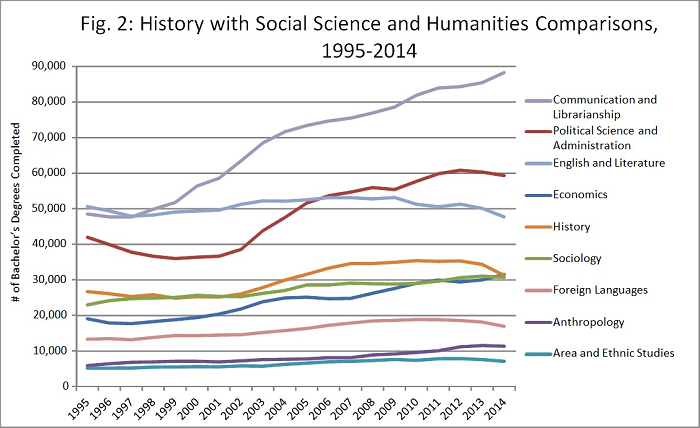
These numbers, according to on-going studies that the AHA is conducting, are part of a larger pattern.  “The available information suggests that the 2014 completion data is more likely than not one step in a downward trend that will play out unevenly across undergraduate programs over the next two to three years.”  Reasons for these declines vary.  My take is that significant increases in the cost of going to college and the weak economy have had a significant role in the decision making of undergraduates and their families.  If a college degree is going to going to cost $100,000 and require an individual student to go into significant debt, then they would rather do that for an engineering degree, or one in marketing, or finance where there is a more tangible return on investment.  The following chart, taken from Perspectives on History and based on the Center for Education Statistics study, shows that the humanities degrees that are bettered coordinated to professional careers than history (economics, journalism/communications, and political science—often seen as a pre-law degree) are doing better in enrollment numbers:  

Fig. 2: History with Social Science and Humanities Comparisons, 1995-2014Another study documents a second trend at play in higher education.  An AHA study shows that students in history Ph.D. programs are increasing.  In 2014 there was a 2.3 percent increase.  The study breaks down the numbers looking at topics: U.S. history dominates (no big surprise) with European history a clear second.

The problem with these studies is that these trends are moving in the exact opposite direction that they need to move.  There are many posts on this blog and articles elsewhere that make it clear that the supply of Ph.D. exceeds demand.  But in the near future that supply is going to increase, and the demand for them to teach undergraduates is going to decrease. The leadership of the historical profession needs to begin looking at ways to turn both trends around.  Individual scholars need to be aware of their current direction and plan their future careers accordingly

Friday, October 28, 2016

Blog CCI (201): Two Books

I have come across two books that discuss a number of interesting topics related to career management in the history profession.  The first is: Rebecca Peabody, The Unruly PhD: Doubts, Detours, Departures, and Other Success Stories (2014).  The other is: Nigel A. Raab, Who is the Historian? (2016).

Both books explore topics of how an individual with a Ph.D. can thrive in the current academic profession.  Peabody's book is a collection of interviews with Ph.D.s from a number of fields.  If nothing else, it is good for letting the reader know that they are not alone in the issues that they are facing; others are confronting the same problems and challenges.  There is a lot more to this book, and many discuss their future employment opportunities. These interviews make it clear that there are several career paths open to Ph.D.s.  Raab's book asks us to realize that there are a number of people that are historians: archivists, museum curators, journalists, and the like.  He says the book is something like a "The Making of..." documentary that one often finds on the DVD releases of major films.  He wants people to see how historians produce history.  These two books should directly and indirectly inspire readers to think about other career options outside of becoming a professor. 

Thursday, October 1, 2015

Blog CXCVIII (198): Should You Take Out Debt to Finance a Ph.D. in History?

The answer to that question really should be an unqualified, "No." Reality, though, is a bit more complicated.

Karen Kelsky, a tenured professor in anthropology at the University of Oregon and then the University of Illinois, directed attention to the debt issue when she decided to conduct a crowdsourcing survey on her website. Kelsky left academia and is now an academic consultant. Her project drew a stunning number of responses due in part to news coverage of it in Slate, The Atlantic, and The Chronicle of Higher Education. According to the story in The Atlantic Ph.D. debt is "the dirty little secret of the ivory tower."

"I thought it would be illuminating to create a crowdsource document that solicited information about how much people owed," Kelsky told the Chronicle. "I was amazed and startled as the numbers started to come in."

That is putting it mildly. The inputs are depressing. It is not uncommon in this study to see students $50,000 or $100,000 in debt. A professor with a Ph.D. in psychology wrote:
I am currently working as an assistant professor in upstate NY. I make $55,000 a year. I am presently on the IRB program with the hopes of getting Public Service Loan Forgiveness in 10 years. However, that clock hasn't even started. My loans have been in forbearance since I graduated. I am currently trying to pay off credit card debt that I accrued for living expenses while in graduate school so I can pay my $500 a month student loan payment. Rather than saving for a house, I will spend the next 10 years saving to pay the taxes on the balance of my loans that will be forgiven. As most of the money from my loan payments will only cover interest I will likely have around $170,000 left on my loan balance when it is forgiven. Unless something miraculous happens I will never be able to save enough money to pay the taxes on that debt forgiveness. I honestly don't know what I will do. I just try to take it one day at a time.
The financing of grad school comes from loans, credit cards, and family financial support. The support from family general comes from two sources: a working spouse, and/or parents/grandparents. People had parents offering loans, paying insurance, buying plane tickets for the holidays, or making car payments for them. One respondent noted that his parents still bought his clothes until he turned 32. Other grad students compensated a little by working part-time, or by having roommates. One recent graduate, said he was still living like a 20-year old even though he was in his early forties. I know that feeling.  I was living in a fraternity house when I went to my high school ten-year reunion. A fact I did not share with anyone at the reunion. What is painfully clear is that graduate school for most is not feasible on fellowships and teaching assistant positions that many graduate students have. "You end up with the message that graduate school is only really financially feasible if you have family resources to fall back on," Kelsky remarked.

Students are using these loans to finance their degrees but also day-to-day living. Often times these expenses include car repair, unexpected health and dental care, tuition and day care for children, rent, travel, and unusual events like weddings.

This type of funding is highly, highly irresponsible. When you owe money at this level, it has enormous long-term ramifications. It forces people to put off having a family, and makes buying a car or a home extremely difficult since they probably will not qualify for a new loan. A reduced standard of living also affects your family. Paying for dance classes, or summer camp, or college for your children becomes difficult, if not impossible. Heavy loan loads limit vacation opportunities and even makes going to conferences and research difficult without a generous grant. A friend of mine who finished off his Ph.D. with credit cards and is over $50,000 in debt and had to stay in a job he disliked even when he had another offer which was in his main area of training, with a lighter work load and at a better school because he could not afford the moving expenses and could not afford to take a slight reduction in pay.

To be blunt: if you have to go into debt a lot that is probably a sign from the universe that a Ph.D. is not for you. Going a $100,000 into debt for a MD is one thing. A physician is going to earn enough to pay off that loan, a Ph.D. in history will not, ever.

But I qualified my answer at the beginning of the essay. Sometimes debt is necessary. I took out two loans for fairly small amounts. One allowed me to earn my MA. Then, five years later, I took out another one to finish writing my dissertation. Even then, it took ten years to pay off the debt. If you find yourself looking at debt as a way to finish, then you need to look at the average yearly income for an individual in your field. That must be your absolute ceiling of debt. (After you go past a full year's salary--and given today's job market assuming one can get a job is a big if--it becomes unlikely that you will ever pay off the debt.)  Even then it should probably be a lot less.

The entire Kelsky survey is available here.

Tuesday, August 4, 2015

Blog CXCVII (197): The Rating Game

ANN ARBOR, MICHIGAN—The Obama administration is backing down on its effort to rank colleges and universities. It sounded like a good idea, but the administration quickly discovered that what sounds good at first, is often quite difficult to turn into a real plan.

Ted Mitchell, the undersecretary of education, was the administration official left to explain this policy retreat to the public. He said efforts to combine many measurements of a school into one score became exceptionally complicated. The administration also wanted to avoid “a black box that would be hard for consumers to penetrate and understand and that actually would not be an advance on the state of the art.” He explained further that the supposed simplicity of a single score “would belie a lot of complexity students and families need to understand. And it would mask some very big differences among institutions.”

Mitchell is right. As a historian, what do I care about the status of the business school. There a lot of other factors. Do students interested in Harvard or Yale really care much about graduation rates for transfer students at those institutions—which probably are very few? Mitchell probably knew that this effort was a foolish one. He is a former president of Occidental College. It has a strong tradition in the liberal arts, but it is not a place you would go to an engineering degree.

Why then, did this blog like idea of ranking history departments in the Clauset, Arbesman, Larremore article, “Systematic Inequality”? The short answer is that article had a specific criteria—the employment of history Ph.D.s at other Ph.D. granting institutions. Even then it had some serious flaws. Strong departments in European history, might not be the right place for an Americanist.

There are some big problems in academia, and some real strenghts.  The main driving force behind the Obama initiative was a good one—to make the system more transparent. Maybe they should have focused on that—standardizing reporting—instead of trying to create a lot more work for a bureaucracy, or to help with the real issues in higher education.    

Thursday, June 18, 2015

Blog CXCII (192): Sarantakes vs. Canary

In January the newsletter of the Society for Historians of American Foreign Relations, Passport, published an article I wrote proposing a series of initiatives the organization could take to help resolve the job crisis. SHAFR is the main organization for U.S. diplomatic historians.  This article was in direct response to another article: Brian C. Etheridge, “SHAFR and the Future of the Profession,” Passport: The Society for Historians of American Foreign Relations Review, vol. 43, no. 1 (April 2012), 50-51.  Ethridge was the associate provost for academic innovation at the University of Baltimore and is now the director of the Center for
Brian C. Etheridge
Teaching Excellence at Georgia Gwinnett College. In this article, he proposed that diplomatic historians adopt Ernest L. Boyer’s four different categories of scholarship in the study of U.S. diplomatic history: the scholarship of discovery; the scholarship of integration; the scholarship of application; and the scholarship of teaching and learning. I had mixed reactions to the article, but it was a stimulating read.  I will not repeat his suggestions in detail.  I would recommend a number of people read it, though.

As I wrote at the time, "The problem with Etheridge’s proposal is that it does not really resolve the big problem facing SHAFR—the fact that there are more historians than history jobs. Even if we do change the nature of what we recognize as scholarship, it will not change that fact."

Do not get me wrong.  Etheridge’s article offers some good ideas.  More importantly, it simulated my own thinking about actions that SHAFR can take to help individual diplomatic historians.  My article is: The proper citation is: Nicholas Evan Sarantakes, "In Search of a Solution: SHAFR and the Jobs Crisis in the History Profession," Passport: The Society for Historians of American Foreign Relations Review, vol. 45, no. 3 (January 2015), 37-38.  Unlike most other organizations representing history sub-fields, SHAFR is a well-organized and funded organization. In the article, I argued "These assets can and should be leveraged to help the more junior members of our field find meaningful employment."  To that end, I offered the following recommendations, which are abridged from the original article:
1. Create two new committees and/or vice-president positions to oversee them. The first should be for schoolteachers. This committee can offer important advice to SHAFR members who want to go into this field on the requirements for getting teaching jobs, which usually vary from state to state... The second should be for professional practitioners: scholars who are using their degrees in government service or history out in the public sphere... The goal would be to make it easier for individuals to move from one field to another. 
2. Diversify and improve the visibility of the SHAFR conference. Most of what SHAFR does at its annual meeting is great and I want to see that continue, but there are certain things that we
can do to offer more services to members. First, we can designate a certain percentage of sessions—perhaps five to ten percent—for discussing the teaching of U.S. diplomatic history... We could also have a series of “The History Ph.D. as . . .” sessions, where several historians who work at institutions other than history departments—think tanks, for example—discuss their experience with and answer questions about these environments. How do you find a job at one of these organizations? How much time do you have to work on your own scholarship? How well does it pay? What unexpected perks or problems are there in this type of work?...  Each session should be devoted to a specific field and have several speakers, since experiences differ... The profession would benefit if we promoted the conference systematically. The more attention the organization and the field receive, the better for all concerned. Raising the profile of diplomatic history helps improve its standing with colleagues in other fields who often make the decisions on what positions a department will hire. SHAFR has done well in having C-SPAN show up and record a few sessions, but we need more than one or two sessions airing at 9 p.m. on a Saturday night... 
3. Provide access to scholarly databases as part of SHAFR membership. SHAFR should make an arrangement with the likes of JSTOR and Project MUSE to make access to these databases a benefit that comes with SHAFR membership. Most SHAFR members will not need this type of assistance, but it will be a real benefit to graduate students, those that have graduated and have lost their access to university libraries, or are doing adjunct work, which often comes with restricted access to university libraries and their subscriptions to these databases... 
4. Write letters. Despite what we like to think about faculty governance, deans rather than faculty committees make the final decisions about the fields in which a department will hire. SHAFR should leverage some of the phenomenal success it has enjoyed of late (three SHAFR members have won the Pulitzer Prize in the last ten years, and another three were finalists) to convince deans to authorize searches for diplomatic historians... 
5. Create summer job placement workshops. My final proposal is that SHAFR begin running a summer workshop for newly minted history Ph.D.s to help them find alternative careers. To be effective, this type of program would have to be a multi-week residential program that combines a mini-MBA course with some training in writing résumés and preparing for interviews. This summer institute should also help with networking and bring in corporate and not-for-profit recruiters to meet with the participants.... 
The objections to this type of program are understandable. Students went to graduate school because they wanted academic careers, and SHAFR is a scholarly organization. Job placement is outside of its mission. These objections are easy to answer. For most people in graduate programs right now, a meaningful academic career is not realistic. The statistics make that clear. The real choice is between a non-academic career (or perhaps it is better describe as an alternative career) or none at all. SHAFR is also in a good position to create such a program...
Andrew Johns, the editor of Passport, arranged for Etheridge to respond to my essay, which he did in the same issue.  The proper citation is: Brian C. Etheridge, "Canary in a Coal Mine," Passport: The Society for Historians of American Foreign Relations Review, vol. 45, no. 3 (January 2015), 38-39.  Below is an excerpt from his article:
I agree with many of the helpful suggestions that Sarantakes has offered about potential actions that SHAFR could take to strengthen the profession. I think his best idea is diversifying the program of the annual SHAFR meeting. Sarantakes is right that more time needs to be devoted to teaching the history of American foreign relations. After all, most professors at most institutions spend most of their time teaching, and most of us have had little or no formal preparation in how to teach effectively. He is also on target in encouraging sessions about employment outside of the academy, led by those who have successfully carved out careers for themselves in other related industries. Finally, I strongly endorse his idea of better promoting the conference to outside stakeholders. I believe that all of these actions would make SHAFR, and by extension the profession, stronger. 
But I’m afraid that I must continue to differ with Sarantakes on the crux of the matter. In this regard, I don’t disagree so much with his prescriptions as with his diagnosis of the problem. In Sarantakes’s view, the really big issue confronting SHAFR is “that there are more historians than history jobs.” While I agree that the jobs crisis is a very real and difficult challenge confronting far too many young, talented historians, I see it as more symptomatic of larger ills facing the profession and discipline... 
In my view, the jobs crisis in diplomatic history, and in the humanities in general, is a product of the larger dilemma facing the liberal arts. States from Virginia to California are in various stages of creating databases that enable them to track student progression through higher education and into the work force. With the growing emphasis in state legislatures on career and workforce development, the liberal arts are often dismissed, as is reflected in the rhetoric of many of the nation’s leaders. “If I’m going to take money from a citizen to put into education,” Republican Governor Rick Scott of Florida declared, “then I’m going to take that money to create jobs.” He later wondered, “Is it a vital interest of the state to have more anthropologists?”... “False [sic] crisis narratives have real effects.” They can lead, for example, to the neglect of the humanities during strategic planning sessions on local campuses. 
To help battle the negative stereotypes surrounding a liberal education, we need to expand our own notion, and in turn the understanding of the public, about what we do. Herein lay my original call for expanding our notion of scholarship—our creative contribution to the body of knowledge—and thus redefining our collective worth to society. In addition to the continuing value we provide to society through our research on the history of America’s encounter with the world, we need to broaden our understanding of our creative activity to include innovations in teaching, the application of our historical understanding to contemporary crises, and collaboration with other disciplines to tackle the big issues: what many have called the “wicked problems” plaguing our global society. SHAFR can support such an agenda, not only by providing more time and space on its annual program, but by helping redefine what counts as creative work in our profession and thereby helping rebrand our profession over time for a larger audience.
I think the exchange was good.  Both of us respected the ideas the other guy was offering.  I also believe both of us would have no problem seeing SHAFR adopt the other guy's ideas.  The journal of the organization, Diplomatic History, already publishes "the scholarship of discovery," and the organization could easily mandate that it have regular features for the other types of scholarship, or it could change the focus of Passport, or it could even create another publication in print or on-line that would produce the other three types of scholarship that Boyer advocated.  As already noted, Ethridge called my suggestions "helplful."  SHAFR has some ideas in front of it, hopefully it will respond in one way or another.  More importantly, hopefully readers of this blog will take these ideas to their own scholarly organizations.

Monday, June 1, 2015

Blog CLXXXVIII (188): Some Other Channels

Many scholarly organizations have a presence on youtube.com.  In fact, looking in the channel search engine using the term "history" produces thousands of results.  Many of these institutions and associations are organizations that regular viewers of this blog might find useful.  They range from museums and archives to the History channel and publishers.  Blocking off an hour or two to look at the various offerings might be time well spent for a good historian.

Given the diverse interests of the people that follow this blog and the fact that "In the Service of Clio" has the mission of focusing on career management, only three of the channels are listed here.  All three seem to do basically the same thing, present videos of history conference sessions.  There are differences, though, and all three are worth a serious and sustained look:

American Historical Association (crest).jpg


Masthead Oah Logo Large

Wednesday, April 29, 2015

Blog CLXXXIV (184): "Overproduction" is Not New

This blog has friends all over the place.  Jeffrey Grey of the University of New South Wales Canberra, the first non-American to serve as president of the Society of Military History, notified me about this article.  This article appeared in the Canadian magazine, University Affairs.  The author is Melonie Fullick, a PhD candidate at York University, writing her dissertation on Canadian post-secondary education policy.  This essay, not surprisingly, focuses on Canadian academic issues, but those in the United States and those in the Great White North are tied closely together.  The thrust of the article is made quite clear in its title: "PhD ‘Overproduction’ is Not New and Faculty Retirements Won’t Solve it. The wave of upcoming retirements is a Myth and PhD numbers Have little to do with the Academic Job Market Anyway." Americans will have to ignore some the Canada-specific factors, but should realize the picture being painted is to the higher education in the United States as Canadian English is to American English.  (Which is to say, they are basically the same).  Enjoy:
In my last post I took a look at some of the history and context of Canadian universities’ hiring of contract faculty. While I was digging around for information, I couldn’t help noticing the relevance of some of the material to another ongoing debate in higher education: that of the “overproduction” of PhDs. Since “too many PhDs” is a recurring theme in media commentary about graduate education Nature, The Economist), I thought I’d explore the issue in more depth and connect it to some of the research I found. Are we really “producing” too many PhDs, and if so, is this a recent problem?
Let’s start with doctoral enrollment increases: how have PhD numbers increased over time, for example in Ontario? Recent graduate expansion has been significant within a short period. On this COU page, we find the specifics spelled out: “Between 2003 and 2011, the government added funding for 15,000 additional graduate spaces. In the 2011 budget, the government announced funding for an additional 6,000 graduate spaces” to 2015. That’s more than 20,000 places added in about 10 years, some of it clearly an echo of the Double Cohort’s undergraduate enrollment bulge. Over that period, PhD students have comprised about 35 percent of total graduate enrollments.
Yet even this most recent expansion isn’t what led to the “overproduction” of PhDs—because of course, it isn’t really a new thing. To return to a paper that I cited in my last post, it’s notable that in 1978 there was already an assumed “PhD dilemma” that was being presented and discussed as a phenomenon of the ’70s, “an imbalance between the rising supply of PhD’s and the declining demand for them, particularly in higher education.” That’s right, 30+ years ago we still had “too many” PhDs.
The key here is that PhD “production” growth has no practical connection to the demand for tenure-track faculty, and it seems likely that it never did. The one time when this may have been the case was the period of rapid massification in the 1960s and early 1970s, and by the time Canadian doctoral programs caught up, demand had dropped again.
If doctoral enrollment is not driven by the need for faculty (i.e. the academic job market), then why do universities expand their PhD numbers? There are plenty of reasons, only a couple of which I’ll touch on here. Firstly, PhD programs bring prestige to a department and contribute to its reputation. Successful supervision of doctoral students also helps with academic faculty career advancement, and brings the pleasure of graduate teaching and mentoring. So if the money is available, the option to expand or create programs is an attractive one.
Another reason is that in Ontario the money has been available, what with the government’s plans to expand graduate enrollments. PhDs bring more government funding than undergraduates, so they’re contributing important resources (both symbolic and material). This is also nothing new; Von Zur-Muehlen (1978) writes that “by 1975-76, Ontario universities were receiving about $12,000 a year from the provincial government, for each PhD student, in addition to tuition fees. Thus, it was in the universities’ interest to expand doctoral enrolment.” It seems that available funding, not academic job market numbers, has been the primary driver of doctoral enrollment.
If “overproduction” has been going on for so long, why is it framed as new, and why has the problem not been addressed by now? Has there ever been a point in the past when every PhD could take an academic job? I’m guessing that other than the aforementioned brief explosion of hiring in the ’60s, the PhD has never been a “golden ticket” to the academic profession. Rather, the many graduates who continue on to other forms of work have been “invisible” because they aren’t held up as examples of success; they simply aren’t “counted.”
The culture of doctoral education as preparation for academe (even when it doesn’t sufficiently fulfil this function) also supports entrenched myths about the academic job market, such as that zombie of a trope, the “Great Wave of Faculty Retirements.” Even now—in 2015—we see the same old idea being trotted out: because so many profs belong to the Baby Boomer generation, we can expect many of them to retire soon, which in turn means new tenure-stream openings for early-career academics. This sounds great, until you look at the facts.
One problem is the expansion of PhD enrollment, as discussed above; this doesn’t entail a directly proportional increase to doctoral graduates, since there is a relatively high attrition rate in the PhD (something else that hasn’t changed since the ’70s). But we’re still seeing far more growth in PhD graduates than in the tenure-track openings available, and there are PhDs still looking for work who graduated two, three, four or more years ago. That reserve pool of potential candidates has to be considered when we look at any job market numbers.
Then there’s the elimination of the mandatory retirement age, which was a process already underway in 1987, with four provinces and the federal government having already completed this step; Ontario followed suit in 2006. Von Zur-Muehlen (1987) also argues that predicting retirement is extremely difficult because it’s not straightforwardly related to age. Lastly, it’s also possible that not all tenured positions will be replaced, especially if demographic trends lead to a decline in undergraduate enrolment.
Of course the “Wave of Retirements” argument is not a new one either. Von Zur-Muehlen points to the 1984 report of the Commission on Canadian Studies report, which predicted that there would be “severe faculty shortages at Canadian universities in the 1990s.” The same arguments appeared again in five-year plans from SSHRC and NSERC, in 1985. Saeed Quazi cites early 1990s studies from the COU, OCUA (Ontario Council on University Affairs) and AUCC. By 2005, the time-frame had shifted: in their book Higher Education in Canada, Beach, Boadway, and McInnis argue that along with “brain drain” to the United States, “there is […] a large number of older faculty at Canadian colleges and universities who will be retiring over the next decade and the Canadian postsecondary education system is simply not producing enough replacements for them.” The predictions of faculty shortages were refuted by research, such as this 1987 paper by Max von Zur-Muehlen, and a 1996 paper by Quazi. Yet somehow the story continued to circulate.
Even the organizations that are promoting increased doctoral enrolments aren’t referring to looming faculty shortages in their arguments (a “disconnect” I explored in more detail in a previous post, here). For example, in the COU’s 2012 Position Paper on Graduate Education, we see the argument that the latter is “crucial for sustaining and developing Ontario’s competitive position in the global, knowledge-based economy. Graduates of advanced research and professional programs in the province develop skills that are not only required in the current marketplace, but are also necessary to innovate and create future enterprises in the fields of business, science, arts and culture.” While the paper also concedes that “graduate education is…central in producing educated citizens who can promote and defend democratic values and ideals,” this sentence stands out amid the economic justifications. This is a call not for more profs, but for “highly qualified personnel.”
It’s clear that other than increased competition, there is no relationship between PhD enrollment and the academic job market, either in the numbers or in the rhetoric employed by government and higher education organizations. Yet somehow no matter how many PhDs enrol and graduate, academic careers are the goal—and the availability of more tenure-track openings is always on the horizon, 10 to 15 years away.
We can’t fool ourselves into thinking that job-market information will trump the culture of denial that persists in many doctoral programs (not that we have great data to begin with). When such a disconnect has persisted for so long, there’s a reason the myth’s been sustained. The “Wave of Retirements” story is only accepted as true because it is repeated over time without any reference to reality, and it’s repeated not just by students but by faculty from whom students seek advice. More importantly, the culture supports this story because we’re seeking ways to justify our efforts, given that primarily one kind of “success” is recognised in academe. This is the academic equivalent of magical thinking.
This helps explain why the actual outcomes of PhDs haven’t been made more explicit. Surely the high rate of attrition not just from doctoral programs but also from the profession could not have gone unnoticed by programs over time, if the goal has been to place students in faculty jobs. And yet we still see a relative silence around this issue, or it’s treated as if it’s only a recent “crisis.”
Any discussion of PhD “overproduction” needs to take into account the important question of the purpose of the PhD. When different groups cannot agree on this purpose, at least in terms coherent enough that they can produce policies and programs that align, then doctoral students are the ones who lose out.
You could argue there’s a danger here of attaching the PhD to some notion of training for the workforce, which would be a corruption of the quest for “knowledge for its own sake.” But then I’d have to ask: if graduate education isn’t instrumental, why is there such a focus on preparation for a particular job, i.e. the tenure-track professor? Surely this is still an instrumental end for the process, and one that is less and less available to graduates. I’d be the last person to argue that the PhD should be “training” for one kind of job or another, but if that’s how it’s already being treated—and if that treatment is reinforcing some destructive myths—let’s not pretend otherwise.

Thursday, April 23, 2015

Blog CLXXXIII (183): Ph.D. Factory

In 2011 the British journal Nature published the article "Education: The PhD factory: The world is producing more PhDs than ever before. Is it time to stop?"  David Cyranoski, Natasha Gilbert, Heidi Ledford, Anjali Nayar, and Mohammed Yahia wrote the article.  Their reporting focuses on the state of higher education in the sciences, since that is the primary subect of the journal.  "In the Service of Clio" focuses on issues involving history, but many of the issues are similar to that professors and students in the liberal arts are facing.  Many of the issues discussed in this article are similar to those that appeared "Doctoral Degrees - The Disposable Academic Why Doing a PhD is Often a Waste of Time," which was originally published in another British publication, The Economist.  That article was reproduced in  Blog LXXIII: The Disposable Academic.  Here is "Education: The PhD factory":
Scientists who attain a PhD are rightly proud—they have gained entry to an academic elite. But it is not as elite as it once was. The number of science doctorates earned each year grew by nearly 40% between 1998 and 2008, to some 34,000, in countries that are members of the Organisation for Economic Co-operation and Development (OECD). The growth shows no sign of slowing: most countries are building up their higher-education systems because they see educated workers as a key to economic growth. But in much of the world, science PhD graduates may never get a chance to take full advantage of their qualifications.
In some countries, including the United States and Japan, people who have trained at great length and expense to be researchers confront a dwindling number of academic jobs, and an industrial sector unable to take up the slack. Supply has outstripped demand and, although few PhD holders end up unemployed, it is not clear that spending years securing this high-level qualification is worth it for a job as, for example, a high-school teacher. In other countries, such as China and India, the economies are developing fast enough to use all the PhDs they can crank out, and more—but the quality of the graduates is not consistent. Only a few nations, including Germany, are successfully tackling the problem by redefining the PhD as training for high-level positions in careers outside academia. Here, Nature examines graduate-education systems in various states of health. 
Japan: A System in Crisis 
Of all the countries in which to graduate with a science PhD, Japan is arguably one of the worst. In the 1990s, the government set a policy to triple the number of postdocs to 10,000, and stepped up PhD recruitment to meet that goal. The policy was meant to bring Japan's science capacity up to match that of the West—but is now much criticized because, although it quickly succeeded, it gave little thought to where all those postdocs were going to end up. 
Academia doesn't want them: the number of 18-year-olds entering higher education has been dropping, so universities don't need the staff. Neither does Japanese industry, which has traditionally preferred young, fresh bachelor's graduates who can be trained on the job. The science and education ministry couldn't even sell them off when, in 2009, it started offering companies around ¥4 million (US$47,000) each to take on some of the country's 18,000 unemployed postdoctoral students (one of several initiatives that have been introduced to improve the situation). "It's just hard to find a match" between postdoc and company, says Koichi Kitazawa, the head of the Japan Science and Technology Agency.
This means there are few jobs for the current crop of PhDs. Of the 1,350 people awarded doctorates in natural sciences in 2010, just over half (746) had full-time posts lined up by the time they graduated. But only 162 were in the academic sciences or technological services,; of the rest, 250 took industry positions, 256 went into education and 38 got government jobs.
With such dismal prospects, the number entering PhD programmes has dropped off. "Everyone tends to look at the future of the PhD labour market very pessimistically," says Kobayashi Shinichi, a specialist in science and technology workforce issues at the Research Center for University Studies at Tsukuba University. 
China: Quantity Outweighs Quality? 
The number of PhD holders in China is going through the roof, with some 50,000 people graduating with doctorates across all disciplines in 2009—and by some counts it now surpasses all other countries. The main problem is the low quality of many graduates.Yongdi Zhou, a cognitive neuroscientist at the East China Normal University in Shanghai, identifies four contributing factors. The length of PhD training, at three years, is too short, many PhD supervisors are not well qualified, the system lacks quality control and there is no clear mechanism for weeding out poor students. 
Even so, most Chinese PhD holders can find a job at home: China's booming economy and capacity building has absorbed them into the workforce. "Relatively speaking, it is a lot easier to find a position in academia in China compared with the United States," says Yigong Shi, a structural biologist at Tsinghua University in Beijing, and the same is true in industry. But PhD graduates can run into problems if they want to enter internationally competitive academia. To get a coveted post at a top university or research institution requires training, such as a postdoctoral position, in another country. Many researchers do not return to China, draining away the cream of the country's crop. 
The quality issue should be helped by China's efforts to recruit more scholars from abroad. Shi says that more institutions are now starting to introduce thesis committees and rotations, which will make students less dependent on a single supervisor in a hierarchical system. "Major initiatives are being implemented in various graduate programmes throughout China," he says. "China is constantly going through transformations." 
Singapore: Growth in All Directions 
 The picture is much rosier in Singapore. Here, the past few years have seen major investment and expansion in the university system and in science and technology infrastructure, including the foundation of two new publicly funded universities. This has attracted students from at home and abroad. Enrolment of Singaporean nationals in PhD programmes has grown by 60% over the past five years, to 789 in all disciplines—and the country has actively recruited foreign graduate students from China, India, Iran, Turkey, eastern Europe and farther afield.
Because the university system in Singapore has been underdeveloped until now, most PhD holders go to work outside academia, but continued expansion of the universities could create more opportunities. "Not all end up earning a living from what they have been trained in," says Peter Ng, who studies biodiversity at the National University of Singapore. "Some have very different jobs—from teachers to bankers. But they all get a good job." A PhD can be lucrative, says Ng, with a graduate earning at least S$4,000 (US$3,174) a month, compared with the S$3,000 a month earned by a student with a good undergraduate degree."I see a PhD not just as the mastery of a discipline, but also training of the mind," says Ng. "If they later practise what they have mastered—excellent—otherwise, they can take their skill sets into a new domain and add value to it." 
United States: Supply Versus Demand 
To Paula Stephan, an economist at Georgia State University in Atlanta who studies PhD trends, it is "scandalous" that US politicians continue to speak of a PhD shortage. The United States is second only to China in awarding science doctorates—it produced an estimated 19,733 in the life sciences and physical sciences in 2009—and production is going up. But Stephan says that no one should applaud this trend, "unless Congress wants to put money into creating jobs for these people rather than just creating supply".
The proportion of people with science PhDs who get tenured academic positions in the sciences has been dropping steadily and industry has not fully absorbed the slack. The problem is most acute in the life sciences, in which the pace of PhD growth is biggest, yet pharmaceutical and biotechnology industries have been drastically downsizing in recent years. In 1973, 55% of US doctorates in the biological sciences secured tenure-track positions within six years of completing their PhDs, and only 2% were in a postdoc or other untenured academic position. By 2006, only 15% were in tenured positions six years after graduating, with 18% untenured.  Figures suggest that more doctorates are taking jobs that do not require a PhD. "It's a waste of resources," says Stephan. "We're spending a lot of money training these students and then they go out and get jobs that they're not well matched for."
The poor job market has discouraged some potential students from embarking on science PhDs, says Hal Salzman, a professor of public policy at Rutgers University in New Brunswick, New Jersey. Nevertheless, production of US doctorates continues apace, fuelled by an influx of foreign students. Academic research was still the top career choice in a 2010 survey of 30,000 science and engineering PhD students and postdocs, says Henry Sauermann, who studies strategic management at the Georgia Institute of Technology in Atlanta. Many PhD courses train students specifically for that goal. Half of all science and engineering PhD recipients graduating in 2007 had spent over seven years working on their degrees, and more than one-third of candidates never finish at all.
Some universities are now experimenting with PhD programmes that better prepare graduate students for careers outside academia. Anne Carpenter, a cellular biologist at the Broad Institute of the Massachusetts Institute of Technology (MIT) and Harvard University in Cambridge, Massachusetts, is trying to create jobs for existing PhD holders, while discouraging new ones. When she set up her lab four years ago, Carpenter hired experienced staff scientists on permanent contracts instead of the usual mix of temporary postdocs and graduate students. "The whole pyramid scheme of science made little sense to me," says Carpenter. "I couldn't in good conscience churn out a hundred graduate students and postdocs in my career."
But Carpenter has struggled to justify the cost of her staff to grant-review panels. "How do I compete with laboratories that hire postdocs for $40,000 instead of a scientist for $80,000?" she asks. Although she remains committed to her ideals, she says that she will be more open to hiring postdocs in the future. 
Germany: The Progressive PhD 
Germany is Europe's biggest producer of doctoral graduates, turning out some 7,000 science PhDs in 2005. After a major redesign of its doctoral education programmes over the past 20 years, the country is also well on its way to solving the oversupply problem.
Traditionally, supervisors recruited PhD students informally and trained them to follow in their academic footsteps, with little oversight from the university or research institution. But as in the rest of Europe, the number of academic positions available to graduates in Germany has remained stable or fallen. So these days, a PhD in Germany is often marketed as advanced training not only for academia—a career path pursued by the best of the best—but also for the wider workforce.
Universities now play a more formal role in student recruitment and development, and many students follow structured courses outside the lab, including classes in presenting, report writing and other transferable skills. Just under 6% of PhD graduates in science eventually go into full-time academic positions, and most will find research jobs in industry, says Thorsten Wilhelmy, who studies doctoral education for the German Council of Science and Humanities in Cologne. "The long way to professorship in Germany and the relatively low income of German academic staff makes leaving the university after the PhD a good option," he says.
Thomas Jørgensen, who heads a programme to support and develop doctoral education for the European University Association, based in Brussels, is concerned that German institutions could push reforms too far, leaving students spending so long in classes that they lack time to do research for their thesis and develop critical-thinking skills. The number of German doctorates has stagnated over the past two decades, and Jørgensen worries about this at a time when PhD production is growing in China, India and other increasingly powerful economies. 
Poland: Expansion at a Cost 
Growth in PhD numbers among Europe's old guard might be waning, but some of the former Eastern bloc countries, such as Poland, have seen dramatic increases. In 1990–91, Polish institutions enrolled 2,695 PhD students. This figure rose to more than 32,000 in 2008–09 as the Polish government, trying to expand the higher-education system after the fall of Communism, introduced policies to reward institutions for enrolling doctoral candidates.
Despite the growth, there are problems. A dearth of funding for doctoral studies causes high drop-out rates, says Andrzej Kraśniewski, a researcher at Warsaw University of Technology and secretary-general of the Polish Rectors Conference, an association representing Polish universities. In engineering, more than half of students will not complete their PhDs, he says. The country's economic growth has not kept pace with that of its PhD numbers, so people with doctorates can end up taking jobs below their level of expertise. And Poland needs to collect data showing that PhDs from its institutions across the country are of consistent quality, and are comparable with the rest of Europe, says Kraśniewski. 
Still, in Poland as in most countries, unemployment for PhD holders is below 3%. "Employment prospects for holders of doctorates remain better than for other higher-education graduates," says Laudeline Auriol, author of an OECD report on doctorate holders between 1990 and 2006, who is now analysing doctoral-student data up to 2010. Still, a survey of scientists by Nature last year showed that PhD holders were not always more satisfied with their jobs than those without the degree, nor were they earning substantially more. 
Egypt: Struggle to Survive 
Egypt is the Middle East's powerhouse for doctoral studies. In 2009, the country had about 35,000 students enrolled in doctoral programmes, up from 17,663 in 1998. But funding has not kept up with demand. The majority comes through university budgets, which are already strained by the large enrolment of students in undergraduate programmes and postgraduate studies other than PhDs. Universities have started turning to international funding and collaborations with the private sector, but this source of funding remains very limited.
The deficit translates into shortages in equipment and materials, a lack of qualified teaching staff and poor compensation for researchers. It also means that more of the funding burden is falling on the students. The squeeze takes a toll on the quality of research, and creates tension between students and supervisors. "The PhD student here in Egypt faces numerous problems," says Mounir Hana, a food scientist and PhD supervisor at Minia University, who says that he tries to help solve them. "Unfortunately, many supervisors do not bother, and end up adding one more hurdle in the student's way." 
Graduates face a tough slog. As elsewhere, there are many more PhD holders in Egypt than the universities can employ as researchers and academics. The doctorate is frequently a means of climbing the civil-service hierarchy, but those in the private sector often complain that graduates are untrained in the practical skills they need, such as proposal writing and project management. Egyptian PhD holders also struggle to secure international research positions. Hana calls the overall quality of their research papers "mediocre" and says that pursuing a PhD is "worthless" except for those already working in a university. But the political upheaval in the region this year could bring about change: many academics who had left Egypt are returning, hoping to help rebuild and overhaul education and research. 
Few PhDs are trained elsewhere in the Middle East—less than 50 a year in Lebanon, for example. But several world-class universities established in the oil-rich Gulf States in recent years have increased demand for PhD holders. So far, most of the researchers have been 'imported' after receiving their degrees from Western universities, but Saudi Arabia and Qatar in particular have been building up their infrastructure to start offering more PhD programmes themselves. The effect will be felt throughout the region, says Fatma Hammad, an endocrinologist and PhD supervisor at Al-Azhar University in Cairo. "Many graduates are now turning to doctoral studies because there is a large demand in the Gulf States. For them, it is a way to land jobs there and increase their income," she says. 
India: PhDs Wanted 
In 2004, India produced around 5,900 science, technology and engineering PhDs, a figure that has now grown to some 8,900 a year. This is still a fraction of the number from China and the United States, and the country wants many more, to match the explosive growth of its economy and population. The government is making major investments in research and higher education—including a one-third increase in the higher-education budget in 2011–12—and is trying to attract investment from foreign universities. The hope is that up to 20,000 PhDs will graduate each year by 2020, says Thirumalachari Ramasami, the Indian government's head of science and technology. Those targets ought to be easy to reach: India's population is young, and undergraduate education is booming. But there is little incentive to continue into a lengthy PhD programme, and only around 1% of undergraduates currently do so. Most are intent on securing jobs in industry, which require only an undergraduate degree and are much more lucrative than the public-sector academic and research jobs that need postgraduate education. Students "don't think of PhDs now, not even master's—a bachelor's is good enough to get a job", says Amit Patra, an engineer at the Indian Institute of Technology in Kharagpur. 
Even after a PhD, there are few academic opportunities in India, and better-paid industry jobs are the major draw. "There is a shortage of PhDs and we have to compete with industry for that resource—the universities have very little chance of winning that game," says Patra. For many young people intent on postgraduate education, the goal is frequently to go to the United States or Europe. That was the course chosen by Manu Prakash, who went to MIT for his PhD and now runs his own experimental biophysics lab at Stanford University in California. "When I went through the system in India, the platform for doing long-term research I didn't feel was well-supported," he says.

Wednesday, March 12, 2014

Blog CLXII (162): Friends Don't Let Friends MOOC

The purpose of this blog is to discuss career management issues in history. It has already discussed the danger that on-line education poses to the new faculty member in Blog CXXXIX (139): On-line Education: More of the Same. Massive On-line Open Courses are another, similar threat, but one that might be fading now.

One of the main reasons Massive On-line Open Courses were popular was that they seemed to offer a way out of the problem of rising college tuition and student loan debt loads. The idea of MOOCs also combined with a traditional American view that technological change is always a good thing.  President Barack Obama stated that MOOCs were the "tide of innovation ...that drives down costs while preserving quality." New York Times columnist Thomas Friedman described MOOCs as a "revolution" and Stanford University President John Hennessy said on-line instruction was a "tsunami coming." Sebastian Thrun, who left Stanford to form Udacity, one of the first companies to implement MOOCs, claimed that in 50 years there would only be 10 universities left on the entire planet.

The hype surrounding MOOCs was not limited to the United States. David Willetts, the British cabinet officer in charge of education said MOOCs would keep Britain's place in the "global race of higher education."

There were some skeptics. Catharine Hill, President of Vassar College, noted: "I don't think we know yet about the quality implications or the cost implication." Karan Khemka of the Parthenon Group noted in the Financial Times, "MOOCs are unlikely to prove a silver bullet for students or universities."

The bloom seems to have come off the MOOC rose. Hennessy recently said MOOCs failed at Stanford on two very important counts: mass and openness. He told the Financial Times that such courses were too large and failed to either engage and motivate the majority of students. "Two words are wrong in MOOC: massive and open," he said. Most people taking online courses at his school were "not ready for the material at the same level" as Stanford students. San Jose State University bailed on the entire concept, noting that MOOCs had a high fail rate.

These problems are not unique to U.S. schools. Edge Hill University England offered a course on Vampires in English literature and of the 1000 students that enrolled, a total of 31 finished. That is a completion rate of 3 percent. And to add insult to injury, none opted to pay so they could receive credit for the course. Not a one.

Reservations about these type of courses is growing. The Babson Survey Research Group has charted the growth of online education over the past decade. In a survey conducted in 2013, asked chief academic officers at 2,831 colleges and universities about online education. The finding: massive open online courses are not sustainable for the schools offering them and "cause confusion about higher-education degrees."

Thrun is admitting defeat. He now works for Google and described Udacity's courses as "a lousy product." Ouch!

The best defense for MOOCs has come from Mike Cassidy, a technology columnist for the San Jose Mercury News: "And here's the thing: Like any technology-based disrupter, it's not so much that the new idea itself will make the world a better or worse place. It's how the new idea is deployed that makes the difference."

The best I can say in responses is maybe, but only maybe. The tide appears to have turned against MOOCs and if so, that is a good thing. That, though, maybe what I want to see. MOOCs are bad for history, bad for education, and bad for historians. They (and a lot of other on-line courses) are a way for institutions to limit the need for classroom instructors. As this essay comes to an end, I am going to repeat what I said in Blog CXXXIX: if you are every offered this type of employment, walk away.

Wednesday, January 8, 2014

Blog CLVII (157): Open Access--A Bad Idea

The book is an old piece of technology. This media format has been around in its basic format despite some changes to its production for over 500 years. A lot of people think the new digital mediums are going to change the industries associated with the book. In Blog LXXVIII (78): E-books: Just Say No I argued that new scholars should not invest their careers in these new media formats for a number of reasons and to stick to traditional media formats. E-books are simply too much of a fade.

A couple of essays that have appeared of late make different arguments that only confirm what I argued back then. Clifford A. Lynch, the executive director of the Coalition for Networked Information, argued in the electronic supplement to the magazine of the American Library Association that e-books have been a bad bet for these depositories. “Some major publishers severely constrain which titles and libraries have access to their e-titles; some are charging very high prices or renting books to libraries for a limited number of loans or a limited time period, or both.”

Joseph J. Esposito, a management consultant in the publishing industry has concluded that: “the ‘promise’ of e-books…has not meaningfully changed the fortunes of the university press world.” His assessment is simple and direct: “electronics are not a strategy; electronics are an enabling technology that has to be put in service to a strategy.” Put another way, there has to be more to an undertaking than a new format. The medium is not the message.

Despite these sound conclusions, the academic journal community is now considering new venues, formats and models of doing business. The open-access movement wants to shift the costs of publication from the consumer or subscriber, to the producer, which is another way of saying the author. The “gold approach” requires articles to be made available on-line free of charge when they are published in print with the author pays a processing fee, for the costs of copyediting, formatting and other publishing task. This fee is significant; as much as $2,000. Another model, the “green approach,” makes a rough copy of a published article available at some type of public repository. In fact, several universities have are pushing policies that require their faculty members to make their published research available to the public.

At the 2014 meeting of the American Historical Association, this issue was debate in a session. “I really believe open access is not a passing fad,” Mary Ellen K. Davis, executive director of the Association of College and Research Libraries, said during her presentation. “I believe open access is a durable feature of the landscape of scholarly communication.”

Robert A. Schneider, a professor of history at Indiana University at Bloomington and editor of the American Historical Review, disagreed. He said there was nothing wrong with the subscription process. “It does work to some degree—arguably to a great degree.” He said the author processing fee is “not only broken, it’s wrong.”

Schneider is right. I think the open access debate reflects an American fascination with technology for its own sake. My little theory is that this focus had something to do with the founding of the United States taking place at the same time as the Industrial Revolution. New technologies, the founding of the new country, and its push westward all offered hope and promise for the future to the people of the new nation.

The problem is the open access movement idea of making authors pay for the right to get published is an approach to information dissemination that is more flawed than current formats. Developing a new approach that requires scholars to pay to have their research published puts even more burdens on new scholars who already stressed enough. The salaries an academic earns are not particular high compared to what their age cohorts in other professions like advertising, or accounting make. These fees could represent a significant portion of their income, assuming they have one. There are a lot of budding scholars that are working adjunct jobs that need publications to establish their credentials to open up employment opportunities and this economic requirement could easily turn into another barrier.

Open access takes the idea that everything on the internet should be free to an unhealthy extreme. In a capatalist society if people are in the business of producing information, then they need to be able to making a living and turn a profit at that effort. The newspaper industry has learned this lesson the hard way. If it is free on the internet, why buy the content on paper? The newspapers that are thriving at the moment are the ones that require subscriptions to access their content on-line like The Wall Street Journal and The Orange County Register. We should also face the fact that the internet is not free. Plenty of people make money from it; from firms like Apple and Dell that produce the machines that we use to get on-line to service providers like Cox and AT&T that charge people monthly fees for access to the digital world.

I should also note I see a little bureaucratic self interest in the open access movement.  It also strikes me that it is a way for librarians to get their libraries out from under budget constraints. If content producers have to pay for journal articles, then they can use their limited dollars for other projects.

What is a scholar to do about these large trends? Push back. Do not contribute content to this open access movement. Fight it when and where you can, be it administrative meetings or in conversations with the people that run the libraries.

It is only your future that is at stake.