Showing posts with label The History Major. Show all posts

Friday, November 11, 2016

Blog CCV (205): So What CAN You Do With A History Major?

As a general rule, I try not to read the blogs of other historians.  Some of them are quite good, but they are generally focused on their fields.  I find all sorts of different fields of history interesting, but at some point you have to say, I just cannot keep up with issues developing in U.S. intellectual history, and/or Medieval European history.  History bloggers also tend to wander off topic a bit; I probably have done that a bit, but only a bit; others wanted to use their forums to talk about the 2016 U.S. presidential election, or the Chicago Cubs winning the World Series. 

With those points made, I do every once and a while--more once than while--I visit other history blogs.  One of the better ones out there is John Fea's "The Way of Improvement Leads Home."  Fea is a religious historian of the 19th Century, and chair of the Department of History at Messiah College in Mechanicsburg, Pennsylvania.  Although his blog focuses a lot on his research and teaching areas, Fea moves around the 19th Century a fair deal, and discusses many other history profession issues.

In 2009 Fea started a series on his blog "So What CAN You Do With A History Major?"  The majority of the entries in this series are interviews with history graduates of Messiah College on what they have done with their degree since graduation, but it is more than a little idiosyncratic.  There are re-postings of other articles, multiple posts about the same person, interviews with guidance counselors, and so on.  This series is aimed at convincing undergraduates and/or their parents that a BA in history is not a waste of a college degree.  Despite that fact, it serves a useful purpose for people in graduate school as a way of generating ideas on what they might do if they are unable to line up gainful employment as professional historians:
  1. Introduction to the Series
  2. "Closing the Gap Between the Liberal-Arts and Career Services"
  3. HNN Intern
  4. Famous History Majors
  5. Police Officer
  6. History Professor
  7. Medical Doctor
  8. You Majored in What?
  9. Jonathan M. Young, Chair, National Council on Disability
  10. The Dartmouth Chart
  11. Five Interviews
  12. Salaries
  13. Librarian
  14. A Passion for History 
  15. Katherine Brooks Interview
  16. Janet Vogel, Librarian, Thurmont Maryland Regional Library System
  17. Scott Keyes, "Stop Asking Me My Major"
  18. Matthew Shaffer, "Educating for the Good Life"
  19. Layne Lebo, Minister, Mechanicsburg Brethern in Christ Church
  20. Go Into Business
  21. A Collection of Articles
  22. Sarah Baker, Documentary Film Maker
  23. Tony Horowitz, Reporter/Writer
  24. Amy Bass, NBC
  25. Sonia Nazario, reporter, Los Angles Times
  26. Interview with Katherine Brooks
  27. Allyson Moore Wall Street Journal guest editorial
  28. AHA Today
  29. Financial Analysis
  30. Bill Stone, Director of Forecasting and Financial Operations, Pearson Education
  31. Salaries
  32. Georgiana Iasnik, Systems Specialist
  33. Cali Pitchel McCullough, Marketing and Communications Associate
  34. Scott Rohrer, editor, National Journal
  35. Philip Bess, Maine Media Workshops
  36. Joshua Kim, Academic Administrator, Dartmouth College
  37. Tara Anderson, program coordinator, CURE International
  38. Matthew Bucher, Church Missionary/Administrator
  39. Jeff Robinson, AmeriCorps
  40. Work For Social Justice
  41. Joe Hackman, Pastor, Salford Mennonite Church, Harleysville, Pennsylvania
  42. Michael Rossi, Documentry Film Maker
  43. "History Majors in the Job Market"
  44. "Want Innovative Thinking? Hire from the Humanities"
  45. Lloyd Blankfein, Chief Executive Officer, Goldman Sachs
  46. Robert “Buddy” Hocutt, Web Content Writer
  47. Megan Talley, Administrative and Programming Coordinator, Hershey Foundation
  48. Michael Adams, Paralegal
  49. Caitlin Babcock, Non-Profit Organization Management Trainee
  50. Brianna LaCassem, Biopharmaceutical Technology, Quality Assurance Analyst
  51. Cali Pitchel, Director of Marketing, Analytic Pros
  52. Jonathan Lewis, Supply Chain Engineer
  53. Cali Pitchel, Director of Marketing, Analytic Pros
  54. David Glenn, Nurse

Saturday, November 5, 2016

Blog CCIII (203): Why History?

The leadership of the history profession has taken notice of the decline in undergraduate history enrollment.  This trend is bad for all of us regardless of where we teach—be it at Princeton, Florida State, or Pasadena City College.  The economics of it is pretty simple—fewer history students means fewer history professors.  In these less than impressive economic times, leaders in our society are questioning the value of what are buying in a college education.  In response, James Grossman, executive director of the American Historical Association wrote an editorial for the Los Angeles Times entitled: "History Isn't a 'Useless' Major: It Teaches Critical Thinking, Something American Needs Plenty More Of."  This piece appeared in the May 30, 2016 issue of the paper.

Most readers of this blog will agree with everything he says, but we are not really his target audience.  This essay is aimed at a much wider audience, and to his credit, Grossman found an important outlet that can reach that general public, or to be more specific, the future college student and his/her parents/legal guardians:
Since the beginning of the Great Recession in 2007, the history major has lost significant market share in academia, declining from 2.2% of all undergraduate degrees to 1.7%. The graduating class of 2014, the most recent for which there are national data, included 9% fewer history majors than the previous year’s cohort, compounding a 2.8% decrease the year before that. The drop is most pronounced at large research universities and prestigious liberal arts colleges. 
This is unfortunate—not just for those colleges, but for our economy and polity. 
Of course it’s not just history.  Students also are slighting other humanities disciplines including philosophy, literature, linguistics and languages. Overall, the core humanities disciplines constituted only 6.1% of all bachelor’s degrees awarded in 2014, the lowest proportion since systematic data collection on college majors began in 1948.
Conventional wisdom offers its usual facile answers for these trends: Students (sometimes pressured by parents paying the tuition) choose fields more likely to yield high-paying employment right after graduation — something “useful,” like business (19% of diplomas), or technology-oriented. History looks like a bad bet. 
Politicians both draw on those simplicities and perpetuate them — from President Barack Obama’s dig against the value of an art history degree to Sen. Marco Rubio’s comment that welders earn more than philosophers. Governors oppose public spending on “useless” college majors. History, like its humanistic brethren, might prepare our young people to be citizens, but it supposedly does not prepare workers — at least not well paid ones.
The diminished prospects for attorneys in recent years extends this logic, as the history major has long been considered among the best preparation for law school. The other conventional career path for history majors is teaching, but that too is suffering weak demand due to pressure on public school budgets. A historian, however, would know that it is essential to look beyond such simplistic logic. Yes, in the first few years after graduation, STEM and business majors have more obvious job prospects — especially in engineering and computer science. And in our recession-scarred economic context, of course students are concerned with landing that first job.
Over the long run, however, graduates in history and other humanities disciplines do well financially. Rubio would be surprised to learn that after 15 years, those philosophy majors have more lucrative careers than college graduates with business degrees. History majors’ mid-career salaries are on par with those holding  business bachelor's degrees. Notably these salary findings exclude those who went on to attain a law or other graduate degree.
The utility of disciplines that prepare critical thinkers escapes personnel offices, pundits and  politicians (some of whom perhaps would prefer that colleges graduate more followers and fewer leaders). But it shouldn’t. Labor markets in the United States and other countries are unstable and unpredictable. In this environment — especially given the expectation of career changes — the most useful degrees are those that can open multiple doors, and those that prepare one to learn rather than do some specific thing.
All liberal arts degrees demand that kind of learning, as well as the oft-invoked virtues of critical thinking and clear communication skills. History students, in particular, sift through substantial amounts of information, organize it, and make sense of it. In the process they learn how to infer what drives and motivates human behavior from elections to social movements to board rooms.
Employers interested in recruiting future managers should understand (and many do) that historical thinking prepares one for leadership because history is about change — envisioning it, planning for it, making it last. In an election season we are reminded regularly that success often goes to whoever can articulate the most compelling narrative. History majors learn to do that.
Everything has a history. To think historically is to recognize that all problems, all situations, all institutions exist in contexts that must be understood before informed decisions can be made. No entity — corporate, government, nonprofit — can afford not to have a historian at the table. We need more history majors, not fewer.

Friday, November 4, 2016

Blog CCII (202): Trending Up and Down

Several new studies have come out that do not bode well for the future.  The numbers from a National Center for Education Statistics, according to an article in the AHA newsletter, Perspectives on History, “show a dramatic decline in the number of bachelor’s degrees in history awarded in 2014.”  History saw a 9.1 percent drop; the third decline in four years.  Not good.

But wait, it gets worse.  A study from the American Academy of Arts & Sciences reports an even bigger decrease of 12 percent for 2014.  (There is as bit of a lag in collecting the data; 2014 might be two years ago, but it is as up-to-date as we are going to get in 2016).

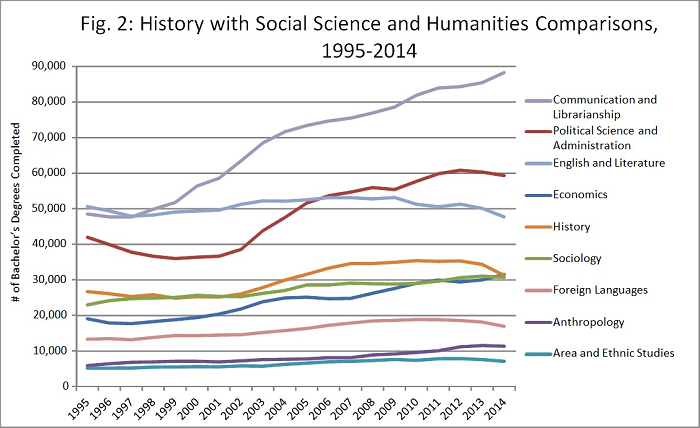
These numbers, according to on-going studies that the AHA is conducting, are part of a larger pattern.  “The available information suggests that the 2014 completion data is more likely than not one step in a downward trend that will play out unevenly across undergraduate programs over the next two to three years.”  Reasons for these declines vary.  My take is that significant increases in the cost of going to college and the weak economy have had a significant role in the decision making of undergraduates and their families.  If a college degree is going to going to cost $100,000 and require an individual student to go into significant debt, then they would rather do that for an engineering degree, or one in marketing, or finance where there is a more tangible return on investment.  The following chart, taken from Perspectives on History and based on the Center for Education Statistics study, shows that the humanities degrees that are bettered coordinated to professional careers than history (economics, journalism/communications, and political science—often seen as a pre-law degree) are doing better in enrollment numbers:  

Fig. 2: History with Social Science and Humanities Comparisons, 1995-2014Another study documents a second trend at play in higher education.  An AHA study shows that students in history Ph.D. programs are increasing.  In 2014 there was a 2.3 percent increase.  The study breaks down the numbers looking at topics: U.S. history dominates (no big surprise) with European history a clear second.

The problem with these studies is that these trends are moving in the exact opposite direction that they need to move.  There are many posts on this blog and articles elsewhere that make it clear that the supply of Ph.D. exceeds demand.  But in the near future that supply is going to increase, and the demand for them to teach undergraduates is going to decrease. The leadership of the historical profession needs to begin looking at ways to turn both trends around.  Individual scholars need to be aware of their current direction and plan their future careers accordingly