I never met Jeff Grey in person. Grey was an Australian military historian who taught at the University of New South Wales at the Australian Defence Force Academy. (A professional military school where the students are either cadets and midshipmen working to earn a commission or commissioned military officers in mid-career.) He was also the editor of the academic journal War & Society.
In 2015 I began working on a feature for the blog--that I still have not finished--on academic publishing. I solicited the views and ideas of journal editors on some of the common mistakes that historians make when writing and submitting articles. We had never met in person, but I wrote to him explaining what I was trying to do. He wrote back almost instantly. (Because of the international date line, he responded nine hours before I sent my note,): "Dear Nick, I do indeed know who you are, and read 'In the Service of Clio' regularly and recommend it to grad students here for its broad perspective and general common sense, 'real world' approach...." He then supplied a number of useful comments. "Hope this is useful. Happy to offer more if needed. JGG."
That same year he achieved a singular honor. He was the first foreign scholar elected to serve as president of the Society of Military History. This past August, before he could finish his term in office, he died suddenly.
In a nice and rather rare gesture, the SMH honored its fallen president, creating a section on its website "Remembering Jeffrey Grey" where friends and colleagues can offer their memories and tributes. Reading this tributes makes it clear that my brief association was typical of the man. He was both a scholar and a gentleman.
Monday, November 7, 2016


Saturday, November 5, 2016
Blog CCIII (203): Why History?
The leadership of the history profession has taken notice of the decline in undergraduate history enrollment. This trend is bad for all of us regardless of where we teach—be it at Princeton, Florida State, or Pasadena City College. The economics of it is pretty simple—fewer history students means fewer history professors. In these less than impressive economic times, leaders in our society are questioning the value of what are buying in a college education. In response, James Grossman, executive director of the American Historical Association wrote an editorial for the Los Angeles Times entitled: "History Isn't a 'Useless' Major: It Teaches Critical Thinking, Something American Needs Plenty More Of." This piece appeared in the May 30, 2016 issue of the paper.
Most readers of this blog will agree with everything he says, but we are not really his target audience. This essay is aimed at a much wider audience, and to his credit, Grossman found an important outlet that can reach that general public, or to be more specific, the future college student and his/her parents/legal guardians:
Most readers of this blog will agree with everything he says, but we are not really his target audience. This essay is aimed at a much wider audience, and to his credit, Grossman found an important outlet that can reach that general public, or to be more specific, the future college student and his/her parents/legal guardians:
Since the beginning of the Great Recession in 2007, the history major has lost significant market share in academia, declining from 2.2% of all undergraduate degrees to 1.7%. The graduating class of 2014, the most recent for which there are national data, included 9% fewer history majors than the previous year’s cohort, compounding a 2.8% decrease the year before that. The drop is most pronounced at large research universities and prestigious liberal arts colleges.
This is unfortunate—not just for those colleges, but for our economy and polity.
Of course it’s not just history. Students also are slighting other humanities disciplines including philosophy, literature, linguistics and languages. Overall, the core humanities disciplines constituted only 6.1% of all bachelor’s degrees awarded in 2014, the lowest proportion since systematic data collection on college majors began in 1948.
Conventional wisdom offers its usual facile answers for these trends: Students (sometimes pressured by parents paying the tuition) choose fields more likely to yield high-paying employment right after graduation — something “useful,” like business (19% of diplomas), or technology-oriented. History looks like a bad bet.
Politicians both draw on those simplicities and perpetuate them — from President Barack Obama’s dig against the value of an art history degree to Sen. Marco Rubio’s comment that welders earn more than philosophers. Governors oppose public spending on “useless” college majors. History, like its humanistic brethren, might prepare our young people to be citizens, but it supposedly does not prepare workers — at least not well paid ones.
The diminished prospects for attorneys in recent years extends this logic, as the history major has long been considered among the best preparation for law school. The other conventional career path for history majors is teaching, but that too is suffering weak demand due to pressure on public school budgets. A historian, however, would know that it is essential to look beyond such simplistic logic. Yes, in the first few years after graduation, STEM and business majors have more obvious job prospects — especially in engineering and computer science. And in our recession-scarred economic context, of course students are concerned with landing that first job.
Over the long run, however, graduates in history and other humanities disciplines do well financially. Rubio would be surprised to learn that after 15 years, those philosophy majors have more lucrative careers than college graduates with business degrees. History majors’ mid-career salaries are on par with those holding business bachelor's degrees. Notably these salary findings exclude those who went on to attain a law or other graduate degree.
The utility of disciplines that prepare critical thinkers escapes personnel offices, pundits and politicians (some of whom perhaps would prefer that colleges graduate more followers and fewer leaders). But it shouldn’t. Labor markets in the United States and other countries are unstable and unpredictable. In this environment — especially given the expectation of career changes — the most useful degrees are those that can open multiple doors, and those that prepare one to learn rather than do some specific thing.
All liberal arts degrees demand that kind of learning, as well as the oft-invoked virtues of critical thinking and clear communication skills. History students, in particular, sift through substantial amounts of information, organize it, and make sense of it. In the process they learn how to infer what drives and motivates human behavior from elections to social movements to board rooms.
Employers interested in recruiting future managers should understand (and many do) that historical thinking prepares one for leadership because history is about change — envisioning it, planning for it, making it last. In an election season we are reminded regularly that success often goes to whoever can articulate the most compelling narrative. History majors learn to do that.
Everything has a history. To think historically is to recognize that all problems, all situations, all institutions exist in contexts that must be understood before informed decisions can be made. No entity — corporate, government, nonprofit — can afford not to have a historian at the table. We need more history majors, not fewer.
Friday, November 4, 2016
Blog CCII (202): Trending Up and Down
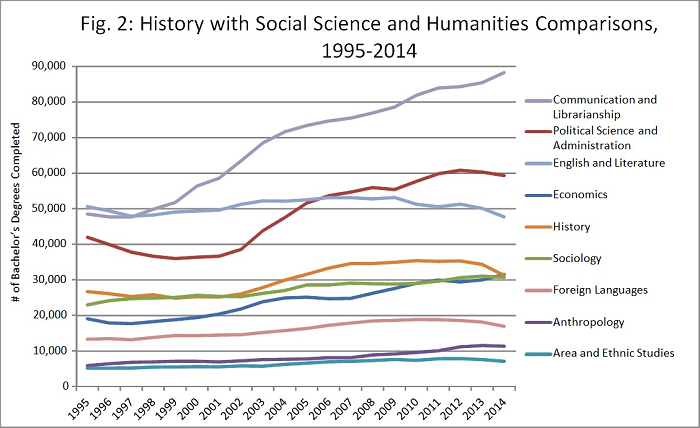
Several new studies have come out that do not bode well for the future. The numbers from a National Center for Education Statistics, according to an article in the AHA newsletter, Perspectives on History, “show a dramatic decline in the number of bachelor’s degrees in history awarded in 2014.” History saw a 9.1 percent drop; the third decline in four years. Not good.
But wait, it gets worse. A study from the American Academy of Arts & Sciences reports an even bigger decrease of 12 percent for 2014. (There is as bit of a lag in collecting the data; 2014 might be two years ago, but it is as up-to-date as we are going to get in 2016).
These numbers, according to on-going studies that the AHA is conducting, are part of a larger pattern. “The available information suggests that the 2014 completion data is more likely than not one step in a downward trend that will play out unevenly across undergraduate programs over the next two to three years.” Reasons for these declines vary. My take is that significant increases in the cost of going to college and the weak economy have had a significant role in the decision making of undergraduates and their families. If a college degree is going to going to cost $100,000 and require an individual student to go into significant debt, then they would rather do that for an engineering degree, or one in marketing, or finance where there is a more tangible return on investment. The following chart, taken from Perspectives on History and based on the Center for Education Statistics study, shows that the humanities degrees that are bettered coordinated to professional careers than history (economics, journalism/communications, and political science—often seen as a pre-law degree) are doing better in enrollment numbers:
 Another study documents a second trend at play in higher education. An AHA study shows that students in history Ph.D. programs are increasing. In 2014 there was a 2.3 percent increase. The study breaks down the numbers looking at topics: U.S. history dominates (no big surprise) with European history a clear second.
The problem with these studies is that these trends are moving in the exact opposite direction that they need to move. There are many posts on this blog and articles elsewhere that make it clear that the supply of Ph.D. exceeds demand. But in the near future that supply is going to increase, and the demand for them to teach undergraduates is going to decrease. The leadership of the historical profession needs to begin looking at ways to turn both trends around. Individual scholars need to be aware of their current direction and plan their future careers accordingly
But wait, it gets worse. A study from the American Academy of Arts & Sciences reports an even bigger decrease of 12 percent for 2014. (There is as bit of a lag in collecting the data; 2014 might be two years ago, but it is as up-to-date as we are going to get in 2016).
These numbers, according to on-going studies that the AHA is conducting, are part of a larger pattern. “The available information suggests that the 2014 completion data is more likely than not one step in a downward trend that will play out unevenly across undergraduate programs over the next two to three years.” Reasons for these declines vary. My take is that significant increases in the cost of going to college and the weak economy have had a significant role in the decision making of undergraduates and their families. If a college degree is going to going to cost $100,000 and require an individual student to go into significant debt, then they would rather do that for an engineering degree, or one in marketing, or finance where there is a more tangible return on investment. The following chart, taken from Perspectives on History and based on the Center for Education Statistics study, shows that the humanities degrees that are bettered coordinated to professional careers than history (economics, journalism/communications, and political science—often seen as a pre-law degree) are doing better in enrollment numbers:
Another study documents a second trend at play in higher education. An AHA study shows that students in history Ph.D. programs are increasing. In 2014 there was a 2.3 percent increase. The study breaks down the numbers looking at topics: U.S. history dominates (no big surprise) with European history a clear second.The problem with these studies is that these trends are moving in the exact opposite direction that they need to move. There are many posts on this blog and articles elsewhere that make it clear that the supply of Ph.D. exceeds demand. But in the near future that supply is going to increase, and the demand for them to teach undergraduates is going to decrease. The leadership of the historical profession needs to begin looking at ways to turn both trends around. Individual scholars need to be aware of their current direction and plan their future careers accordingly
Friday, October 28, 2016
Blog CCI (201): Two Books
I have come across two books that discuss a number of interesting topics related to career management in the history profession. The first is: Rebecca Peabody, The Unruly PhD: Doubts, Detours, Departures, and Other Success Stories (2014). The other is: Nigel A. Raab, Who is the Historian? (2016).
Both books explore topics of how an individual with a Ph.D. can thrive in the current academic profession. Peabody's book is a collection of interviews with Ph.D.s from a number of fields. If nothing else, it is good for letting the reader know that they are not alone in the issues that they are facing; others are confronting the same problems and challenges. There is a lot more to this book, and many discuss their future employment opportunities. These interviews make it clear that there are several career paths open to Ph.D.s. Raab's book asks us to realize that there are a number of people that are historians: archivists, museum curators, journalists, and the like. He says the book is something like a "The Making of..." documentary that one often finds on the DVD releases of major films. He wants people to see how historians produce history. These two books should directly and indirectly inspire readers to think about other career options outside of becoming a professor.
Both books explore topics of how an individual with a Ph.D. can thrive in the current academic profession. Peabody's book is a collection of interviews with Ph.D.s from a number of fields. If nothing else, it is good for letting the reader know that they are not alone in the issues that they are facing; others are confronting the same problems and challenges. There is a lot more to this book, and many discuss their future employment opportunities. These interviews make it clear that there are several career paths open to Ph.D.s. Raab's book asks us to realize that there are a number of people that are historians: archivists, museum curators, journalists, and the like. He says the book is something like a "The Making of..." documentary that one often finds on the DVD releases of major films. He wants people to see how historians produce history. These two books should directly and indirectly inspire readers to think about other career options outside of becoming a professor.
Tuesday, November 3, 2015
Blog CC (200): Honors to the Blog...Again
A note worth making. Last week's posting set a "In the Service of Clio" record for the most postings in one year.
Look for a flurry of commentary in the next few weeks as the blog returns to active duty.
Look for a flurry of commentary in the next few weeks as the blog returns to active duty.
Wednesday, October 28, 2015
Blog CXCIX (199): Reviewing the Official Historian
HONOLULU, HAWAII—A few weeks ago I read an article that John M. Carland, a historian working in the office of the Secretary of Defense, wrote in Headquarters Gazette, the newsletter of the Society for Military History. In "Why the American Historical Review Will Not Review Official History and Why It Should" he documented his discovery that the journal of the American Historical Association will not review in its book review section official histories produced by the various armed services.
In his article Carland quoted at length from his correspondence with Robert A. Schneider, the editor of the AHR: "Indeed, on the face of it, [he continued] there certainly shouldn’t be any distinction between scholarly books based upon their provenance—it’s the scholarship that should count. That is, if the book is scholarly—and if it meets our other criteria, then it should be reviewed by the AHR as well as other journals. The fact is, however, that these 'other criteria,' not the origins or publisher of the book, are often what disqualifies it." The journal Schneider notes gets a lot of books and basically does not review biographies, collections of documents, edited volumes, textbooks, second editions, or books aimed at a general audience.
In crafting his response, Schneider also turned to his book review editor who was direct, if ill informed. “It is the commission that is problematic: what are its terms and limitations? How much of the source material is publically [sic] available, and how much requires access only granted to scholars who agree to certain conditions?” In further communication, Schneider doubled down on this point. The problem with official histories is that they "often rely upon sources that cannot be verified or often even consulted by outside historians. I think it’s reasonable at least to assert this as a potential obstacle. Furthermore, there is the question of the disinterestedness, independence, and autonomy of a historian who is employed by or belongs to the institution or enterprise which he’s investigating."
There are a number of problems with these responses. First, as Carland discovered, the AHR has over the years reviewed official military history from the United States, the United Kingdom, France, Canada, Germany and Russia.
A second problem is that it leads the journal to ignore major events on its own home turf. McNamara, Clifford, and The Burdens of Vietnam by Edward Drea was a volume in the official series on the development of the Office of the Secretary of Defense. It got a lot of attention for its findings. “This is not your standard, bland official history,” George C. Herring of the University of Kentucky, one of the leading scholars on the Vietnam War noted in a news story The Washington Post did on the book. The coverage of that book was nothing compared to Black Soldier, White Army: The 24th Infantry Regiment in Korea by William Bowers, William Hammond, and George MacGarrigle. The 24th Infantry was one of the last segregated, all-black units in the U.S. Army and many veterans of the unit spent 17 years lobbying the U.S. Army to commission this book, arguing that the first volume of the Army's official history of the Korean War, South to the Naktong, North to the Yalu gave a devastating account of the regiment's performance in combat when it stated the regiment broke under fire and ran from the enemy. When Black Soldier, White Army failed to exonerate the unit, showing that the 24th had indeed collapsed in combat, veterans of the regiment threatened to sue to prevent the release of the book. This controversy was the subject of news stories in the New York Times, Chicago Tribune, Los Angeles Times, Baltimore Sun, and USA Today. This book was the subject of a four-page review from Russell Weigley, a former president of the Society for Military History, in Reviews in American History. And yet, nothing in the AHR. That seems wrong.
A final problem with the AHR's criteria is that it is based on ignorance and a tad bit of exaggerated self-importance. In most ways, the official history program is designed to help large government agencies learn about what worked and what did not work, and why. The program—at least in the U.S. Army—has been implemented to facilitate historical coverage, not offer sanitized version of what happened that glorify the military. General of the Army Dwight D. Eisenhower made this point clear in the order authorizing the U.S. Army in World War II. Historians working for the military—who almost always have Ph.D.s—have often been concerned about being considered court historians. Ronald Spector, the first civilian ever to serve as the chief of Naval History and now a professor at George Washington University, pushed back against the court historian view in a famous article: Ronald Spector, "An Improbable Success Story: Official Military Histories in the Twentieth Century" The Public Historian vol. 12, no. 1 (Winter 1990), 25-30. As Spector shows, the system they work in mitigates against such a development. The regulations governing the official histories, require detailed citation to the documents. These historians can use any source material they wish; memoirs, oral histories (that they often conduct themselves), and official documents. If they use documents that are still classified, the publication of the official history becomes grounds for those documents to be declassified. Forrest C. Pogue, who is considered by many public historians to be a pioneer in the field, said one of the reasons he worked on the official Army histories was to facilitate the declassification process. One final point: many things make policy: state interests, politics, etc. History is not one of them. At least in the United States. The Secretary of Defense—and his staff—are busy people, dealing with difficult issues involving Russians in the Ukraine and Iran's interest in nuclear weapons. They do not really have time to worry about Black Soldier, White Army: The 24th Infantry Regiment in Korea or even McNamara, Clifford, and The Burdens of Vietnam. If the people at the American Historical Review think that historians have that kind of influence, or that components of the military that are dealing with contemporary issues are concerned about events from four to seven decades past, they are fooling themselves. Americans—even those in the in military—just do not hold on to historical issues for long.
As you might tell, I have mixed reactions to this little controversy. First, I am a book review editor myself for Presidential Studies Quarterly and I understand the American Historical Review perspective. I really do. We do not get the volume of books the American Historical Review does, but one of the first things you learn as an editor is how much of the literature you do not know. If I am facing this problem with books about Theodore Roosevelt—is this book important? Who do I ask to review the book?—I suspect the folks at the AHR are facing this problem on a much, much larger scale. The second thing is that you will get books that are just not appropriate for the journal. You have to have criteria for saying no. It must be professional in nature, and you have to be able to explain it clearly to people that are going to be disappointed with your reply. (All of this has happened to me.)
On the other hand, it is the AHR. Although people like to claim that this journal is the flagship publication in the historical profession, it is not. There are just too many people, working in too many diverse sub-fields for one journal to claim to be the publication of record for all historical time periods and topics. The AHR made sense the 1910s when the history departments at major schools like the University of Wisconsin or the University of Texas had four and five members, and one of them might have been "the Europeanist" or "the Americanist." Even after the journal outlived its usefulness, book reviews in the AHR still served a real purpose when it reviewed major works in various fields. The purpose of a book review is to let you know what books you need to read, and which ones you do not. A journal that offered a comprehensive and broad collection of books about various historical topics and time periods was really, really useful. The AHR managed to do that until sometime in the early to mid-1990s. You can have a good career without getting reviewed in the AHR. Of my five books, all listed to the side, only one—the Olympic book—has been reviewed in that journal. (This point was driven home during a research trip I took in August to the Gerald R. Ford Presidential Library. I was waiting for the archivists to deliver some documents I had requested and was thumbing through several journals that were available on the rack of current periodicals to which the Library subscribed. The AHR was one of them and I went to the book review section, and was stunned at how nothing in the entire section seemed even slightly relevant to my research, teaching, or simple history buff interests. Maybe that is just me, but it is generally not a good reaction for a journal that wants to be the main publication in the field of history.)
The criteria that the Review uses also seems to be counter to its own interests. The AHR does not review biographies. That seems quite shortsighted to me. I do not even understand why. There is an entire Pulitzer Prize category for biography. Another wrong call, is the refusal to review books that are aimed at the general public. Some of these are simplistic trash, but others are quite innovative and have significant impact on the historiography of their field. Even if they are not that good, they get attention that the field has to respond to, if for no other reason than to dismiss it, and one of the ways it does that is through the review process. Bad reviews have utility. Just to repeat myself: the purpose of a book review is to let you know what books you need to read, and which ones you do not.
The biggest reason the AHR and its staff are wrong is that the history profession might be on the verge of undergoing a fairly large transformation. Back in October 2011 Anthony T. Grafton and James Grossman, the president and executive director of the American Historical Association wrote an article "No More Plan B: A Very Modest Proposal for Graduate Programs in History" in which they said history departments need to realize that that many or maybe most of their graduate students would end up pursuing non-academic jobs and careers. I was a bit skeptical about that article, but it does seem that the AHA has increased efforts to support initiatives in this direction. If the AHA is serious about supporting scholars in non-academic careers, then the Review needs to be serious about treating scholars doing non-academic work seriously. If people are writing about history and getting an audience, even if it is not through peer reviewed publications, the AHR needs to be offering assessments of those works.
Then again, maybe the Association is not serious about its Plan B efforts. Or maybe there is a schism in the AHA that I am not aware of; one branch of the AHR might be refusing to support the effortr of another branch. I do not know. One thing is clear: for their own good and the good of the profession the staff and editors of the AHR need to rethink their policy and/or offer a better explanation.
In his article Carland quoted at length from his correspondence with Robert A. Schneider, the editor of the AHR: "Indeed, on the face of it, [he continued] there certainly shouldn’t be any distinction between scholarly books based upon their provenance—it’s the scholarship that should count. That is, if the book is scholarly—and if it meets our other criteria, then it should be reviewed by the AHR as well as other journals. The fact is, however, that these 'other criteria,' not the origins or publisher of the book, are often what disqualifies it." The journal Schneider notes gets a lot of books and basically does not review biographies, collections of documents, edited volumes, textbooks, second editions, or books aimed at a general audience.
In crafting his response, Schneider also turned to his book review editor who was direct, if ill informed. “It is the commission that is problematic: what are its terms and limitations? How much of the source material is publically [sic] available, and how much requires access only granted to scholars who agree to certain conditions?” In further communication, Schneider doubled down on this point. The problem with official histories is that they "often rely upon sources that cannot be verified or often even consulted by outside historians. I think it’s reasonable at least to assert this as a potential obstacle. Furthermore, there is the question of the disinterestedness, independence, and autonomy of a historian who is employed by or belongs to the institution or enterprise which he’s investigating."
A second problem is that it leads the journal to ignore major events on its own home turf. McNamara, Clifford, and The Burdens of Vietnam by Edward Drea was a volume in the official series on the development of the Office of the Secretary of Defense. It got a lot of attention for its findings. “This is not your standard, bland official history,” George C. Herring of the University of Kentucky, one of the leading scholars on the Vietnam War noted in a news story The Washington Post did on the book. The coverage of that book was nothing compared to Black Soldier, White Army: The 24th Infantry Regiment in Korea by William Bowers, William Hammond, and George MacGarrigle. The 24th Infantry was one of the last segregated, all-black units in the U.S. Army and many veterans of the unit spent 17 years lobbying the U.S. Army to commission this book, arguing that the first volume of the Army's official history of the Korean War, South to the Naktong, North to the Yalu gave a devastating account of the regiment's performance in combat when it stated the regiment broke under fire and ran from the enemy. When Black Soldier, White Army failed to exonerate the unit, showing that the 24th had indeed collapsed in combat, veterans of the regiment threatened to sue to prevent the release of the book. This controversy was the subject of news stories in the New York Times, Chicago Tribune, Los Angeles Times, Baltimore Sun, and USA Today. This book was the subject of a four-page review from Russell Weigley, a former president of the Society for Military History, in Reviews in American History. And yet, nothing in the AHR. That seems wrong.
A final problem with the AHR's criteria is that it is based on ignorance and a tad bit of exaggerated self-importance. In most ways, the official history program is designed to help large government agencies learn about what worked and what did not work, and why. The program—at least in the U.S. Army—has been implemented to facilitate historical coverage, not offer sanitized version of what happened that glorify the military. General of the Army Dwight D. Eisenhower made this point clear in the order authorizing the U.S. Army in World War II. Historians working for the military—who almost always have Ph.D.s—have often been concerned about being considered court historians. Ronald Spector, the first civilian ever to serve as the chief of Naval History and now a professor at George Washington University, pushed back against the court historian view in a famous article: Ronald Spector, "An Improbable Success Story: Official Military Histories in the Twentieth Century" The Public Historian vol. 12, no. 1 (Winter 1990), 25-30. As Spector shows, the system they work in mitigates against such a development. The regulations governing the official histories, require detailed citation to the documents. These historians can use any source material they wish; memoirs, oral histories (that they often conduct themselves), and official documents. If they use documents that are still classified, the publication of the official history becomes grounds for those documents to be declassified. Forrest C. Pogue, who is considered by many public historians to be a pioneer in the field, said one of the reasons he worked on the official Army histories was to facilitate the declassification process. One final point: many things make policy: state interests, politics, etc. History is not one of them. At least in the United States. The Secretary of Defense—and his staff—are busy people, dealing with difficult issues involving Russians in the Ukraine and Iran's interest in nuclear weapons. They do not really have time to worry about Black Soldier, White Army: The 24th Infantry Regiment in Korea or even McNamara, Clifford, and The Burdens of Vietnam. If the people at the American Historical Review think that historians have that kind of influence, or that components of the military that are dealing with contemporary issues are concerned about events from four to seven decades past, they are fooling themselves. Americans—even those in the in military—just do not hold on to historical issues for long.
As you might tell, I have mixed reactions to this little controversy. First, I am a book review editor myself for Presidential Studies Quarterly and I understand the American Historical Review perspective. I really do. We do not get the volume of books the American Historical Review does, but one of the first things you learn as an editor is how much of the literature you do not know. If I am facing this problem with books about Theodore Roosevelt—is this book important? Who do I ask to review the book?—I suspect the folks at the AHR are facing this problem on a much, much larger scale. The second thing is that you will get books that are just not appropriate for the journal. You have to have criteria for saying no. It must be professional in nature, and you have to be able to explain it clearly to people that are going to be disappointed with your reply. (All of this has happened to me.)
On the other hand, it is the AHR. Although people like to claim that this journal is the flagship publication in the historical profession, it is not. There are just too many people, working in too many diverse sub-fields for one journal to claim to be the publication of record for all historical time periods and topics. The AHR made sense the 1910s when the history departments at major schools like the University of Wisconsin or the University of Texas had four and five members, and one of them might have been "the Europeanist" or "the Americanist." Even after the journal outlived its usefulness, book reviews in the AHR still served a real purpose when it reviewed major works in various fields. The purpose of a book review is to let you know what books you need to read, and which ones you do not. A journal that offered a comprehensive and broad collection of books about various historical topics and time periods was really, really useful. The AHR managed to do that until sometime in the early to mid-1990s. You can have a good career without getting reviewed in the AHR. Of my five books, all listed to the side, only one—the Olympic book—has been reviewed in that journal. (This point was driven home during a research trip I took in August to the Gerald R. Ford Presidential Library. I was waiting for the archivists to deliver some documents I had requested and was thumbing through several journals that were available on the rack of current periodicals to which the Library subscribed. The AHR was one of them and I went to the book review section, and was stunned at how nothing in the entire section seemed even slightly relevant to my research, teaching, or simple history buff interests. Maybe that is just me, but it is generally not a good reaction for a journal that wants to be the main publication in the field of history.)
The criteria that the Review uses also seems to be counter to its own interests. The AHR does not review biographies. That seems quite shortsighted to me. I do not even understand why. There is an entire Pulitzer Prize category for biography. Another wrong call, is the refusal to review books that are aimed at the general public. Some of these are simplistic trash, but others are quite innovative and have significant impact on the historiography of their field. Even if they are not that good, they get attention that the field has to respond to, if for no other reason than to dismiss it, and one of the ways it does that is through the review process. Bad reviews have utility. Just to repeat myself: the purpose of a book review is to let you know what books you need to read, and which ones you do not.
The biggest reason the AHR and its staff are wrong is that the history profession might be on the verge of undergoing a fairly large transformation. Back in October 2011 Anthony T. Grafton and James Grossman, the president and executive director of the American Historical Association wrote an article "No More Plan B: A Very Modest Proposal for Graduate Programs in History" in which they said history departments need to realize that that many or maybe most of their graduate students would end up pursuing non-academic jobs and careers. I was a bit skeptical about that article, but it does seem that the AHA has increased efforts to support initiatives in this direction. If the AHA is serious about supporting scholars in non-academic careers, then the Review needs to be serious about treating scholars doing non-academic work seriously. If people are writing about history and getting an audience, even if it is not through peer reviewed publications, the AHR needs to be offering assessments of those works.
Then again, maybe the Association is not serious about its Plan B efforts. Or maybe there is a schism in the AHA that I am not aware of; one branch of the AHR might be refusing to support the effortr of another branch. I do not know. One thing is clear: for their own good and the good of the profession the staff and editors of the AHR need to rethink their policy and/or offer a better explanation.
Thursday, October 1, 2015
Blog CXCVIII (198): Should You Take Out Debt to Finance a Ph.D. in History?
The answer to that question really should be an unqualified, "No."
Reality, though, is a bit more complicated.
Karen Kelsky, a tenured professor in anthropology at the University of Oregon and then the University of Illinois, directed attention to the debt issue when she decided to conduct a crowdsourcing survey on her website. Kelsky left academia and is now an academic consultant. Her project drew a stunning number of responses due in part to news coverage of it in Slate, The Atlantic, and The Chronicle of Higher Education. According to the story in The Atlantic Ph.D. debt is "the dirty little secret of the ivory tower."
"I thought it would be illuminating to create a crowdsource document that solicited information about how much people owed," Kelsky told the Chronicle. "I was amazed and startled as the numbers started to come in."
That is putting it mildly. The inputs are depressing. It is not uncommon in this study to see students $50,000 or $100,000 in debt. A professor with a Ph.D. in psychology wrote:
Students are using these loans to finance their degrees but also day-to-day living. Often times these expenses include car repair, unexpected health and dental care, tuition and day care for children, rent, travel, and unusual events like weddings.
This type of funding is highly, highly irresponsible. When you owe money at this level, it has enormous long-term ramifications. It forces people to put off having a family, and makes buying a car or a home extremely difficult since they probably will not qualify for a new loan. A reduced standard of living also affects your family. Paying for dance classes, or summer camp, or college for your children becomes difficult, if not impossible. Heavy loan loads limit vacation opportunities and even makes going to conferences and research difficult without a generous grant. A friend of mine who finished off his Ph.D. with credit cards and is over $50,000 in debt and had to stay in a job he disliked even when he had another offer which was in his main area of training, with a lighter work load and at a better school because he could not afford the moving expenses and could not afford to take a slight reduction in pay.
To be blunt: if you have to go into debt a lot that is probably a sign from the universe that a Ph.D. is not for you. Going a $100,000 into debt for a MD is one thing. A physician is going to earn enough to pay off that loan, a Ph.D. in history will not, ever.
But I qualified my answer at the beginning of the essay. Sometimes debt is necessary. I took out two loans for fairly small amounts. One allowed me to earn my MA. Then, five years later, I took out another one to finish writing my dissertation. Even then, it took ten years to pay off the debt. If you find yourself looking at debt as a way to finish, then you need to look at the average yearly income for an individual in your field. That must be your absolute ceiling of debt. (After you go past a full year's salary--and given today's job market assuming one can get a job is a big if--it becomes unlikely that you will ever pay off the debt.) Even then it should probably be a lot less.
The entire Kelsky survey is available here.
Karen Kelsky, a tenured professor in anthropology at the University of Oregon and then the University of Illinois, directed attention to the debt issue when she decided to conduct a crowdsourcing survey on her website. Kelsky left academia and is now an academic consultant. Her project drew a stunning number of responses due in part to news coverage of it in Slate, The Atlantic, and The Chronicle of Higher Education. According to the story in The Atlantic Ph.D. debt is "the dirty little secret of the ivory tower."
"I thought it would be illuminating to create a crowdsource document that solicited information about how much people owed," Kelsky told the Chronicle. "I was amazed and startled as the numbers started to come in."
That is putting it mildly. The inputs are depressing. It is not uncommon in this study to see students $50,000 or $100,000 in debt. A professor with a Ph.D. in psychology wrote:
I am currently working as an assistant professor in upstate NY. I make $55,000 a year. I am presently on the IRB program with the hopes of getting Public Service Loan Forgiveness in 10 years. However, that clock hasn't even started. My loans have been in forbearance since I graduated. I am currently trying to pay off credit card debt that I accrued for living expenses while in graduate school so I can pay my $500 a month student loan payment. Rather than saving for a house, I will spend the next 10 years saving to pay the taxes on the balance of my loans that will be forgiven. As most of the money from my loan payments will only cover interest I will likely have around $170,000 left on my loan balance when it is forgiven. Unless something miraculous happens I will never be able to save enough money to pay the taxes on that debt forgiveness. I honestly don't know what I will do. I just try to take it one day at a time.The financing of grad school comes from loans, credit cards, and family financial support. The support from family general comes from two sources: a working spouse, and/or parents/grandparents. People had parents offering loans, paying insurance, buying plane tickets for the holidays, or making car payments for them. One respondent noted that his parents still bought his clothes until he turned 32. Other grad students compensated a little by working part-time, or by having roommates. One recent graduate, said he was still living like a 20-year old even though he was in his early forties. I know that feeling. I was living in a fraternity house when I went to my high school ten-year reunion. A fact I did not share with anyone at the reunion. What is painfully clear is that graduate school for most is not feasible on fellowships and teaching assistant positions that many graduate students have. "You end up with the message that graduate school is only really financially feasible if you have family resources to fall back on," Kelsky remarked.
Students are using these loans to finance their degrees but also day-to-day living. Often times these expenses include car repair, unexpected health and dental care, tuition and day care for children, rent, travel, and unusual events like weddings.
This type of funding is highly, highly irresponsible. When you owe money at this level, it has enormous long-term ramifications. It forces people to put off having a family, and makes buying a car or a home extremely difficult since they probably will not qualify for a new loan. A reduced standard of living also affects your family. Paying for dance classes, or summer camp, or college for your children becomes difficult, if not impossible. Heavy loan loads limit vacation opportunities and even makes going to conferences and research difficult without a generous grant. A friend of mine who finished off his Ph.D. with credit cards and is over $50,000 in debt and had to stay in a job he disliked even when he had another offer which was in his main area of training, with a lighter work load and at a better school because he could not afford the moving expenses and could not afford to take a slight reduction in pay.
To be blunt: if you have to go into debt a lot that is probably a sign from the universe that a Ph.D. is not for you. Going a $100,000 into debt for a MD is one thing. A physician is going to earn enough to pay off that loan, a Ph.D. in history will not, ever.
But I qualified my answer at the beginning of the essay. Sometimes debt is necessary. I took out two loans for fairly small amounts. One allowed me to earn my MA. Then, five years later, I took out another one to finish writing my dissertation. Even then, it took ten years to pay off the debt. If you find yourself looking at debt as a way to finish, then you need to look at the average yearly income for an individual in your field. That must be your absolute ceiling of debt. (After you go past a full year's salary--and given today's job market assuming one can get a job is a big if--it becomes unlikely that you will ever pay off the debt.) Even then it should probably be a lot less.
The entire Kelsky survey is available here.
Subscribe to:
Posts (Atom)


